Key Takeaways
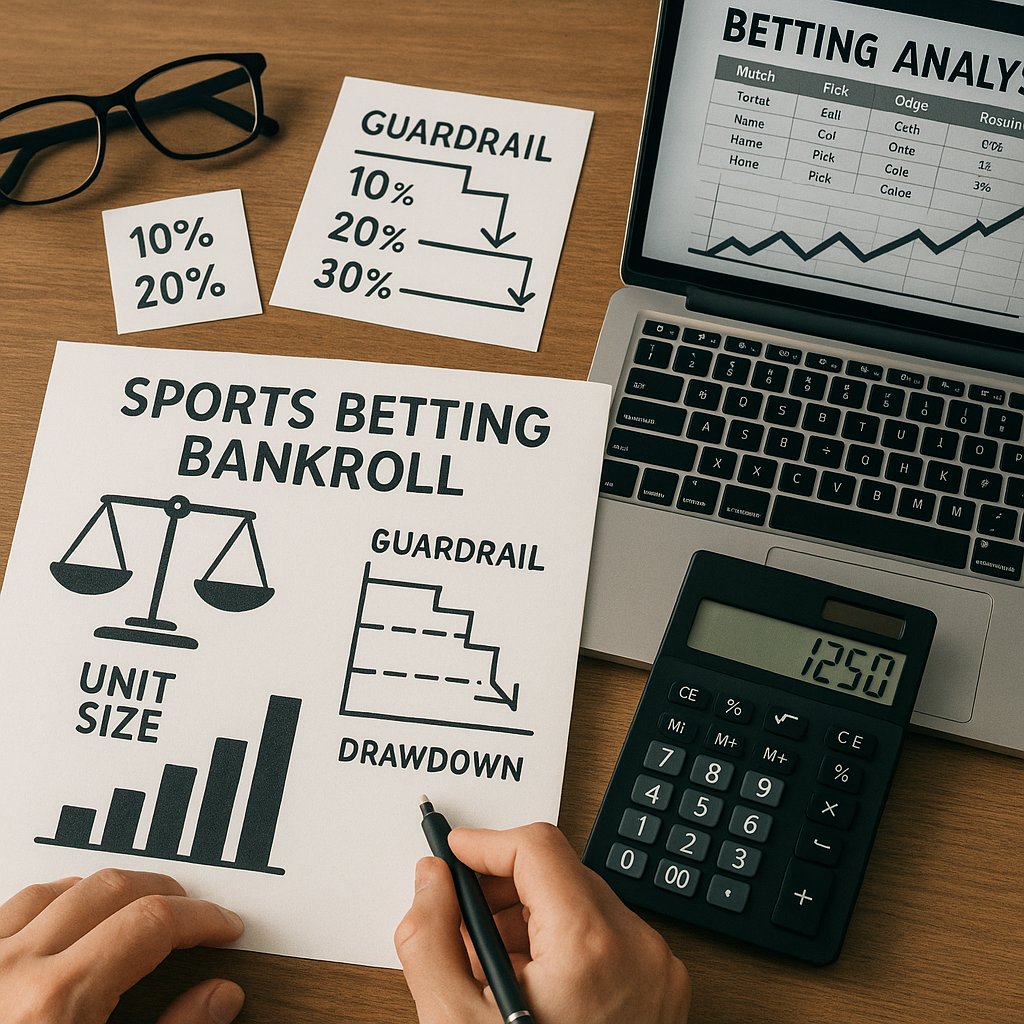
- Define a maximum acceptable drawdown (e.g., 20–30% of bankroll) in advance and treat it as a hard stop where you must pause or significantly reduce action.
- Set a consistent unit size as a small percentage of your bankroll (typically 0.5–2%) so individual bets can’t meaningfully threaten your long-term survival.
- Use strict caps on parlay exposure—both maximum stake size and maximum total odds—to prevent a few high-variance bets from dominating your risk profile.
- Implement automated stop-loss rules with your book or betting tools (daily, weekly, and overall) that lock you out or cut limits once preset loss thresholds are hit.
- Regularly recalculate unit size and limits as your bankroll changes so your guardrails adapt to growth or drawdowns without letting emotional decisions creep in.
Table of Contents
- What Does “Drawdown” Really Mean for a Sportsbetting Bankroll?
- How Do You Turn a Lump Sum Into Guardrailed Units and Risk Buckets?
- Which Daily, Weekly, and Peak-Drawdown Limits Actually Prevent Overexposure?
- How Should You Treat Parlays So They Don’t Blow Up Your Guardrails?
- How Do Online Casino Sessions Fit Into a Bankroll With Drawdown Guardrails?
- How Can You Use Sportsbook Rules, Errors, and Account Features to Protect Your Bankroll?
- How Do You Build a Written Guardrail Plan and Actually Stick to It Over Time?
- FAQ
What Does “Drawdown” Really Mean for a Sportsbetting Bankroll?
Expert Insight: According to www.covers.com, being a good handicapper isn’t enough to guarantee long-term profit in sports betting; disciplined bankroll management—often using fixed “units” as a set percentage of your total bankroll—is critical to managing risk and staying profitable over time (https://www.covers.com/guides/sports-betting-bank-roll-management-and-roi). (www.covers.com)
In sportsbetting, drawdown is the peak-to-trough decline in your bankroll over a period of time. It’s not just a bad day or a losing bet; it’s the largest percentage drop from a recent high point to a later low point before you recover.
Example:
- You build your bankroll from $1,000 to $1,400.
- You then drop to $900 before climbing again.
- Your drawdown from the $1,400 peak is ($1,400 – $900) / $1,400 = 35.7%.
Why this matters more than simple wins and losses:
- Psychology: A 30–50% drawdown makes it much harder to stay disciplined. That’s when people chase, tilt, and blow up accounts.
- Math: The deeper the drawdown, the harder it is to recover. Lose 50%, you need a 100% return just to get back to even.
- Risk of ruin: Without guardrails, a string of normal variance can wipe out your bankroll even if you’re a good handicapper.
This is why drawdown guardrails are different from generic bankroll management. Traditional guidelines talk about unit size and “bet within your means.” Guardrails add explicit stopping rules, caps, and checkpoints that keep your exposure under control even when emotions are running hot.
Think of guardrails as:
- Speed limits: Maximum stake per bet, per day, per market.
- Crash barriers: Automatic stop points when losses hit a defined level.
- Routing rules: Limits on risky products like parlays or certain online casino games.
The goal isn’t to avoid all losses; that’s impossible. The goal is to make sure no single losing streak, bad beat, or sportsbook error can take your bankroll from healthy to crippled in a single run.
How Do You Turn a Lump Sum Into Guardrailed Units and Risk Buckets?
Before you can install drawdown guardrails, you need to convert your raw bankroll into a structured framework: units and risk buckets.
1. Define your true bankroll (not just your current balance)
Your bankroll is the total amount you are genuinely willing to dedicate to betting over a season or time horizon, across every betting site and online casino account combined.
- Include: funds already deposited + funds you plan to deposit.
- Exclude: rent, bills, emergency savings, or any money you can’t afford to lose.
Example: You decide your season bankroll is $2,000, split between two sportsbooks and a small online casino balance.
2. Choose a unit size that fits your risk tolerance
A unit is your base bet size. Most disciplined bettors use somewhere between 0.5% and 2% of bankroll per unit:
- Ultra-conservative: 0.25–0.5% of bankroll per unit.
- Standard: 1% of bankroll per unit.
- Aggressive: 2% of bankroll per unit (only if you truly understand variance).
With a $2,000 bankroll:
- 0.5% unit = $10.
- 1% unit = $20.
- 2% unit = $40.
Once set, your guardrails will be expressed in units rather than dollars so they naturally scale if your bankroll grows or shrinks.
3. Create “risk buckets” for different bet types
Not all bets are equal. A single straight bet at -110 and a 5-leg parlay are not the same risk, even if the dollars are identical. Build buckets like:
- Core edge bets: Straight sides/totals where you truly believe you have an edge.
- Higher-volatility bets: Parlays, futures, long-shot props.
- Entertainment-only bets: Live sweats, same-game parlays you build for fun, or casual online casino spins/hands.
Then assign maximum unit sizes per bucket:
- Core edge bets: up to 1–2 units per play.
- High-volatility bets (including parlay tickets): 0.25–0.5 units per play, strictly capped.
- Entertainment bets and online casino: 0.1–0.25 units max and a separate micro-bankroll.
This bucketed structure is a core guardrail: it stops you from accidentally risking 5–10% of your bankroll on a parlay or a handful of high-variance casino spins.
4. Standardize your staking approach
For most bettors, a simple flat-betting or “bet-to-win” system works best:
- Flat betting: Risk 1 unit on almost every straight bet, regardless of odds, within your bucket limits.
- Bet-to-win: Risk enough to win 1 unit on favorites (e.g., risk $110 to win $100 at -110; risk $150 to win $100 at -150) and risk 1 unit on underdogs.
Whatever you choose, tie it to your unit and bucket rules. Consistency is what makes drawdown guardrails work in practice.
Which Daily, Weekly, and Peak-Drawdown Limits Actually Prevent Overexposure?
Guardrails become real when you set hard numbers for when to stop betting, slow down, or reduce stakes. These limits protect you from tilt, overconfidence, and “just one more” decisions.
1. Daily loss limit: When do you stop for the day?
A daily loss limit is the maximum you’re allowed to lose in one calendar day before you must shut everything down.
- Common range: 2–5 units per day.
- Conservative example: If your unit is $20, a 4-unit loss limit = $80. Lose $80 net on the day, you’re done.
Why it works:
- Prevents chasing late games or live bets to “get even.”
- Turns a potentially catastrophic day into a manageable setback.
2. Weekly loss limit: How do you contain bad runs?
Weekly limits protect you when a bad stretch lasts several days.
- Typical range: 10–20 units per week.
- Example: With a $20 unit, a 15-unit weekly limit = $300. Hit -15 units from Monday to Sunday, you pause until next week.
You can pair this with a “cool-down” rule: if you hit the weekly cap, take at least one full day off to review bets and results instead of forcing more action.
3. Peak-to-trough drawdown limit: When do you go into “defense mode”?
The most powerful guardrail is a peak drawdown threshold that triggers automatic changes when your bankroll drops a certain percentage from its high water mark.
Practical tiers:
- Tier 1 (warning): 10–15% drawdown from peak.
- Action: Cut unit size by 25%, reduce parlay volume, no new futures.
- Tier 2 (defense): 20–25% drawdown from peak.
- Action: Cut unit size by 50%, no parlays at all, no online casino until you recover.
- Tier 3 (hard brake): 30–35% drawdown from peak.
- Action: Stop betting for a set period (e.g., 7–14 days) and fully review your approach.
Example:
- Your bankroll peaks at $2,400.
- Tier 1: If you drop to $2,040 (15% drawdown), you reduce unit size and parlay volume.
- Tier 2: At $1,800 (25%), you slash unit size in half and eliminate high-volatility plays.
- Tier 3: At $1,560 (35%), you stop and reevaluate.
4. Product-specific limits: What caps do you set on parlays and futures?
Certain bet types create natural overexposure because they tie up a lot of value in one outcome or a chain of outcomes.
- Parlays: Cap total daily parlay exposure at 1–2 units, regardless of number of slips.
- Season-long futures: Cap all open futures at 5–10% of bankroll.
- Same-game parlays: Treat them as entertainment: 0.25-unit max each, 1 unit total per day.
5. Portfolio limits: How much on one team, game, or narrative?
Overexposure also happens when you stack related bets on the same event.
- Limit total exposure on any single game or team (including parlays, props, and futures) to 3–5 units.
- Count correlated bets together. A side + same-game parlay + player prop on the same angle should be tracked as a single risk cluster.
These numeric rules are the backbone of real drawdown protection. If you obey them mechanically, you’ll stay in the game long enough for your edge—if you truly have one—to matter.
How Should You Treat Parlays So They Don’t Blow Up Your Guardrails?
Parlays are one of the fastest ways to break your drawdown guardrails without realizing it. They pack multiple outcomes into one ticket, concentrate variance, and are heavily promoted by almost every modern betting site.
1. Why parlays create hidden overexposure
From a risk perspective, parlays can be dangerous because:
- Correlation: Many legs are related. For example, a team to win and their quarterback to go over passing yards live or in a same-game parlay. If the team underperforms, multiple legs die at once.
- Variance: Even “safe” legs compound risk. Hitting three -250 favorites in a parlay is much harder than winning a single -250 straight bet.
- Psychology: The lure of big payouts encourages bettors to overshoot normal unit sizes.
2. Set strict parlay-specific rules
To keep parlays inside your guardrails, write rules like:
- Max stake per parlay: 0.25–0.5 units.
- Max daily parlay exposure: 1–2 units total across all tickets.
- Max legs per parlay: 3–4 legs for most bettors; more legs only for tiny “lottery” tickets (0.1 units or less).
Example:
- Your unit is $20.
- Each parlay: max $5–$10.
- Total parlays in a day: no more than $20 risked, regardless of how many slips.
3. Separate “edge” parlays from “lottery” tickets
Not all parlays are pure gambles. Sometimes you combine two correlated edges for better payouts. Still, they should be capped:
- Edge-driven parlays: 0.25–0.5 units when you can justify each leg.
- Lottery parlays: 0.05–0.1 units, framed as entertainment only.
Label them clearly in your tracking sheet so you don’t fool yourself into thinking a 10-leg same-game parlay is a serious investment.
4. Avoid stacking parlays on the same narrative
Overexposure often looks like:
- Side bet on Team A -3.
- Same-game parlay with Team A ML + QB over + WR over.
- Live bet on Team A in the second half.
If Team A flops, your exposure explodes. Instead:
- Count all related parlays and props in that game toward a single game cap (e.g., 3–5 units max).
- Prefer one clean straight bet over multiple correlated parlays.
5. Use guardrails to resist promotions
Bonuses, odds boosts, and profit boosts are often targeted at parlay behavior. To keep them from breaking your rules:
- Only use boosts within your existing parlay limits—never expand stakes just to “maximize” a promo.
- If a boost requires a higher stake than your 0.5-unit parlay cap, skip it.
Parlays can be fun and even strategically useful, but only if they live inside a strict framework. Guardrails let you enjoy parlay action without letting it dominate your risk profile.
How Do Online Casino Sessions Fit Into a Bankroll With Drawdown Guardrails?
Many modern players move fluidly between sportsbetting and online casino games on the same betting site or app. That convenience can quietly wreck your guardrails if you don’t separate the risk.
1. Recognize that casino variance is different
Online casino games (slots, roulette, blackjack, etc.) have:
- Fast betting cycles: Dozens or even hundreds of spins or hands per hour.
- Built-in house edge: Over enough volume, the expected result is negative.
- Short-term volatility: Big swings over small time frames.
This combination can chew through a sports bankroll quickly—especially if you jump into casino games after a losing day to chase losses.
2. Create a separate, tiny casino bankroll
To keep casino risk in check, implement these rules:
- Allocate a fixed percentage of your total bankroll to casino play, such as 2–5% maximum.
- Treat that amount as a fully expendable entertainment budget, not an investment.
- Never top up the casino pool with sports funds in the same week if you bust it.
Example:
- Total bankroll: $2,000.
- Online casino allocation: 3% = $60.
- Once $60 is gone, no more casino until your next monthly or quarterly reset.
3. Define session limits: time, loss, and win
Session-based guardrails keep casino play from spiraling:
- Time limit: e.g., 30–60 minutes per session.
- Loss limit: e.g., 25–50% of your casino mini-bankroll per session.
- Win stop: e.g., if you double your casino mini-bankroll in one session, walk away.
These rules reduce the chance that a hot run turns into a giveback or that a cold run wipes out your entire casino allocation in a single sitting.
4. Keep unit sizes tiny compared to sports bets
Casino bet sizes should be much smaller than your sports units:
- If your sports unit is $20, casino spins or hands might be $0.50–$2.
- Avoid big single bets (like $25+ per spin) that would equal or exceed your sports stake.
That way, even an unlucky stretch in the casino only dents your entertainment slice, not your main betting bankroll.
5. Don’t let casino play “leak” into sports discipline
Guardrails should explicitly forbid using casino wins to justify larger sports bets the same day. Likewise, they should forbid jumping into the casino after a bad slate of games.
- No “I’m up 10 units today, I’ll take a shot in the casino.”
- No “I’ll hit blackjack to win back tonight’s NBA losses.”
Your rules exist to protect your bankroll from exactly that kind of emotional decision-making.
If you enjoy combining sportsbetting and online casino action on a single platform, make sure your written plan specifies how much goes to each, what the limits are, and when you must stop. Without that, casino volatility can quickly overwhelm even solid sports edges.
How Can You Use Sportsbook Rules, Errors, and Account Features to Protect Your Bankroll?
Drawdown guardrails aren’t only about how much you bet. They’re also about how you interact with the underlying sportsbook environment—its rules, errors, and built-in tools.
1. Know the house rules so you don’t overexpose by accident
Every betting site has detailed rules about:
- How voids, pushes, and cancellations are handled.
- What happens when lines move or events are postponed.
- How live betting and cash-out work.
Misunderstanding these can produce surprise swings in your bankroll. For example:
- You assume a leg will void in a parlay, but the site settles it as a loss.
- You think a suspended game will carry over but it’s graded differently.
Reading the sportsbook rules isn’t exciting, but it’s part of real risk control. You want to know exactly how your bets will settle before you stake them.
2. Protect yourself from grading errors and disputes
Occasionally, sportsbooks make mistakes when grading bets or posting markets. High-profile cases have shown how one error can damage the relationship between bettor and book and create unexpected swings.
Your guardrails should include:
- Verification habit: After big wins or losses, double-check grading against official box scores or play-by-play.
- Documentation: Screenshot key slips and markets, especially for unusual props or long-shot bets.
- Patience rule: Don’t immediately re-stake large amounts based on an unexpected balance change until you confirm the result is correct.
This keeps you from over-betting money that may later be clawed back after an error is fixed.
3. Use built-in responsible gambling tools as automated guardrails
Most modern sportsbooks and casino apps offer tools that align perfectly with drawdown management:
- Deposit limits: Cap how much you can add per day, week, or month.
- Loss limits: Some sites let you define a maximum net loss over a period.
- Session time limits: Helpful for online casino play, where time-on-device drives volume.
- Cool-off or self-exclusion: Temporary or long-term time-outs when you recognize problem patterns.
Convert your personal rules into platform-level settings when possible. Automated enforcement prevents you from overriding your own guardrails in the heat of the moment.
4. Diversify across books without multiplying risk
Using multiple sportsbooks is smart for line shopping, but it can also mask how much you’re really risking if you think in “per-account” terms rather than total bankroll.
- Track bets across all accounts in one central log.
- Apply your daily, weekly, and drawdown limits to the combined exposure, not per site.
- Avoid mirroring the same big position at multiple books unless it’s part of a deliberate strategy.
5. Be cautious with live betting and cash-out options
Live betting and cash-out can be useful tools but also a major source of impulsive overexposure.
- Set a specific live-betting allocation (e.g., 1–2 units per day) and stick to it.
- Use cash-out only as part of a pre-defined plan (e.g., hedging a future) rather than panic reactions to short-term swings.
By aligning your personal rules with the sportsbook’s tools and policies, you create a layered defense: your own discipline, plus platform-enforced limits, plus clear expectations about how bets will settle.
How Do You Build a Written Guardrail Plan and Actually Stick to It Over Time?
Guardrails only work if they’re explicit, written down, and reviewed regularly. Treat your bankroll like a small trading account: you need a simple risk policy and a feedback loop.
1. Write a one-page “Bankroll Guardrail Charter”
Put your rules in writing. One page is enough if it’s concrete. Include:
- Bankroll size: Total amount and timeframe (e.g., $2,000 for the NFL and NBA season).
- Unit size: Percentage of bankroll and dollar amount.
- Bet types and buckets: What bets you place, which bucket they belong to, and their max unit size.
- Daily and weekly loss limits: In units and dollars.
- Drawdown tiers: At what percentage from peak you cut units, eliminate parlays, or stop entirely.
- Parlay and online casino limits: Separate caps on stake and volume.
- Use of sportsbook tools: Deposit caps, timeouts, and any self-imposed app limits.
Print it, save it as a PDF, or pin it in a notes app. The key is that it’s visible and fixed, not something you “keep in your head.”
2. Track every bet with just enough detail
You don’t need a complex database, but you do need a log. For each bet, capture:
- Date and time.
- Sport and market (spread, total, prop, parlay, online casino session, etc.).
- Stake in units and dollars.
- Odds and book.
- Result and profit/loss.
At least once a week, compute:
- Total units won/lost.
- ROI: (Profit / Total amount wagered) × 100.
- Current bankroll and current peak drawdown from your high water mark.
Seeing your performance in units and ROI keeps you focused on long-term process, not just recent streaks.
3. Install behavioral rules for common danger zones
Many of the biggest bankroll blowups happen in predictable emotional states. Pre-write rules like:
- After a big win: No new markets added that day; stick to your pre-planned slate only.
- After a crushing bad beat: No live bets or additional parlays; review the game tomorrow.
- Late-night rule: No bets placed after a certain hour when you’re tired or impaired.
These “meta-guardrails” protect you from yourself when your decision-making is weakest.
4. Schedule periodic reviews and adjustments
Every month or quarter, sit down for a structured review:
- Did you respect your daily, weekly, and drawdown limits?
- Which bet types performed best or worst?
- How much of your action came from parlays or online casino sessions?
- Is your unit size still appropriate for your bankroll and risk tolerance?
This is also when you can rebalance: if your bankroll grows, you may increase units slightly; if you’ve hit a prolonged drawdown, you may decide to permanently lower unit size.
5. Choose betting environments that support discipline
Some platforms make it easier to stay disciplined by offering clear tracking, configurable limits, and transparent rules. If you’re looking for a betting site that supports a structured, guardrail-based approach, consider starting with a reputable operator such as this recommended betting site, and then immediately set your deposit and loss limits to match your written plan.
6. Accept that small edges and modest ROI are normal
Long-term, serious bettors usually aim for a modest positive ROI, often in the low single digits. That’s still excellent over hundreds or thousands of bets. Your guardrails are there so that:
- One emotional decision doesn’t erase weeks of steady grinding.
- Normal variance doesn’t push you into desperate, high-stakes bets.
- Your sportsbetting and online casino activity remains an enjoyable, controlled part of your life, not a source of financial stress.
When you combine clear unit sizing, strict caps on parlays and casino play, well-defined drawdown triggers, and honest tracking, you turn a raw bankroll into a resilient system. That’s what truly prevents overexposure—no matter how wild the games get.
FAQ
Q: What are bankroll drawdown guardrails in sports betting?
A: Bankroll drawdown guardrails are predetermined rules that limit how much of your total bankroll you can lose in a given period or streak. They define hard stop points and bet size limits so you avoid catastrophic losses when variance goes against you.
Q: How do I choose the right unit size for my bankroll?
A: A common approach is to make one unit 0.5%–2% of your total bankroll, depending on how aggressive you want to be. Smaller unit sizes reduce volatility and make it easier to ride out losing streaks without hitting your guardrails too quickly.
Q: How can I use stop-loss rules to avoid overexposure?
A: Stop-loss rules cap how much you’re allowed to lose in a day, week, or month before you must stop betting. For example, you might set a 5% daily or 15% monthly drawdown limit and automatically pause all action once that limit is hit.
Q: Why should I cap the size and number of parlays I place?
A: Parlays amplify variance and can drain a bankroll quickly if you stake too much or play them too often. Capping parlay stake sizes and limiting how many you place per day or week keeps them from overwhelming your overall risk plan.
Q: How do I know when to adjust my bankroll guardrails?
A: Revisit your guardrails whenever your bankroll changes significantly or your betting style evolves. If you’re consistently hitting stop-loss limits or rarely coming close to them, that’s a sign to recalibrate your unit size, limits, or parlay caps.