Table of Contents
- Overview: Parlay Logic Meets Table Game Betting Systems
- How Table Game Parlays Really Work: Independent Events and House Edge
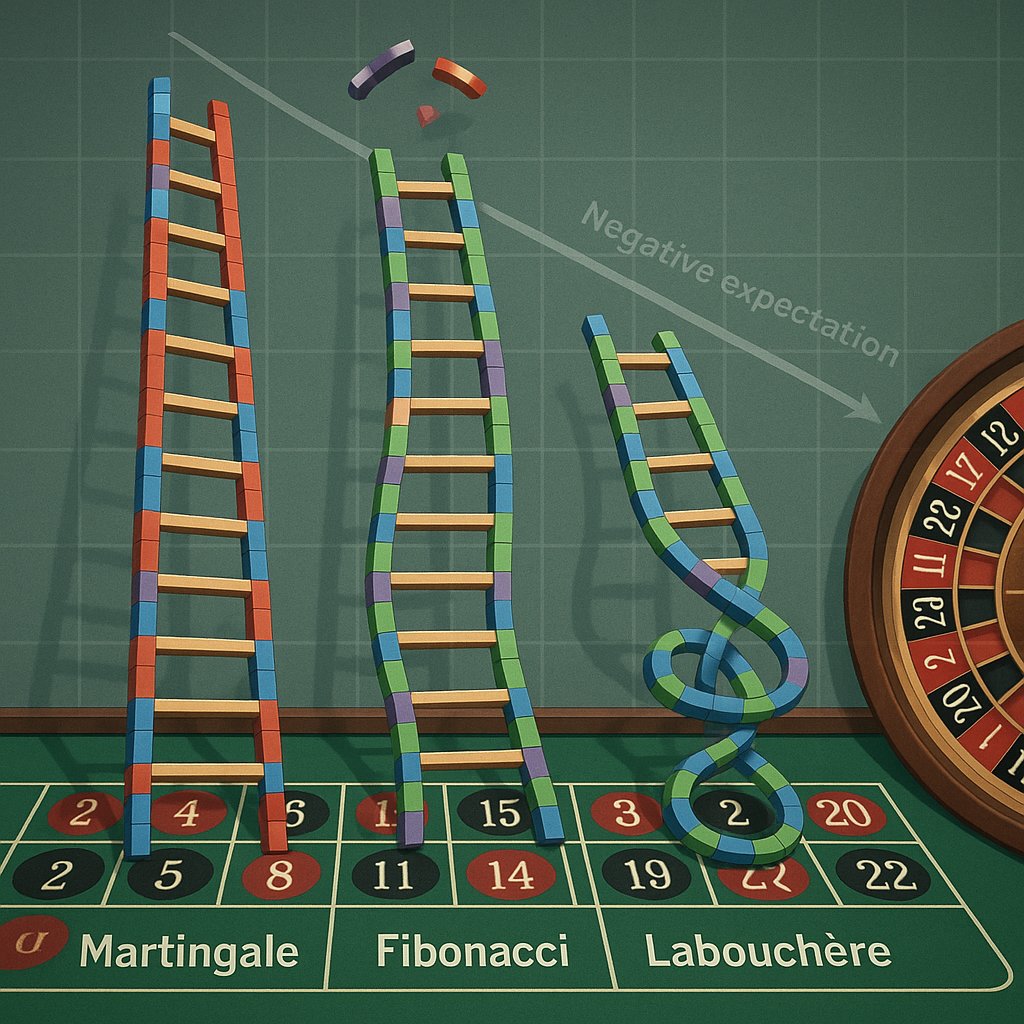
- Martingale on Table Games: Why Doubling Until You Win Eventually Breaks
- Fibonacci and Labouchère: Slower Progressions, Same Long-Run Failure
- Why Parlay-Style Systems Cannot Beat a Negative Expectation
- Gambler’s Fallacy, Risk Psychology, and Why These Systems Feel Like They Work
- What This Means for Sportsbetting Parlays and Choosing a Betting Site
- Practical Guidelines: Playing Without Falling for Betting System Myths
- FAQ: Online Casino Parlay Systems and Progressive Betting
- Conclusion: Why Long-Run Math Beats Short-Run Parlay Illusions
Overview: Parlay Logic Meets Table Game Betting Systems
Expert Insight: According to wizardofodds.com, no betting system can overcome or even reduce the house advantage in games like roulette or craps because each spin or toss is independent and, over the long run, your loss rate converges to the game’s expected house edge (https://wizardofodds.com/gambling/betting-systems/). (wizardofodds.com)
Parlay-style thinking is everywhere in modern betting. On a sportsbetting slip it shows up as multi-leg parlays; at an online casino table it shows up as progressive systems like Martingale, Fibonacci, and Labouchère that “roll” risk from one spin or hand into the next. The pitch is always the same: stack small events together, or escalate stakes after a loss, to convert a modest edge into a steady profit.
Authoritative gambling experts, including resources like Wizard of Odds and long-running forums such as Wizard of Vegas, have tested these systems extensively. The verdict is consistent: they do not beat the house edge, and over long horizons they usually lose faster than simple flat betting.
This article explains why parlay-style progression systems fail on table games, how the same logic applies to parlay betting on sports, and what that means if you play at a betting site regularly. You will see how the combination of independent outcomes, fixed negative expectation, and exponential bet growth guarantees that Martingale, Fibonacci, and Labouchère eventually run into bankroll or table limits.
How Table Game Parlays Really Work: Independent Events and House Edge
To understand why betting systems fail, you have to start with the two pillars of casino math: independence of events and house edge.
Independence of events means that each spin of roulette, roll of the dice in craps, or shuffle of cards in baccarat is not affected by what happened before. Whether red hit 10 times in a row or the pass line won five times straight, the next outcome has the same probabilities as always. This is why the Wizard of Odds and other math-focused sites emphasize that dice and roulette wheels “have no memory.”
House edge is the average percentage the casino expects to win on each bet over the long run. For common even-money style wagers:
- European roulette red/black has a house edge of about 2.7%.
- American roulette red/black is about 5.26%.
- Craps pass line is roughly 1.41%.
- Baccarat banker bet is roughly 1.06% (ignoring commission nuances).
Every time you make one of these bets, your expected value is negative, even though outcomes will jump around in the short run. Crucially, no betting pattern changes that mathematical expectation. Whether you flat bet, double, triple, or use an elaborate number sequence, the underlying game still pays you less than fair odds.
This is also how parlay bets in sports work. When you link multiple games into one parlay on a betting site, the house edge from each leg compounds into a larger disadvantage. Action Network’s parlay education explains that even if each leg is slightly mispriced in your favor, combining them magnifies variance and makes it harder to realize the edge in practice.
Parlay-style progression systems for table games do the same thing in reverse: they promise smooth profits by turning one negative-expectation bet after another into a chain, but they never touch the fundamental disadvantage on each wager.
Martingale on Table Games: Why Doubling Until You Win Eventually Breaks
The Martingale system is the purest parlay-style progression. You:
- Bet 1 unit on an even-money outcome (e.g., red/black in roulette).
- If you lose, double your bet.
- Keep doubling after each loss until you win, then reset to 1 unit.
The logic is seductive. One win recovers all previous losses plus 1 unit of profit. A sample sequence:
- Lose 1 → balance -1
- Lose 2 → balance -3
- Lose 4 → balance -7
- Win 8 → balance +1 net
On paper, this looks like guaranteed profit as long as you “eventually” win. In reality, a few critical facts kill the system:
- Long losing streaks are more common than most players expect. Even on a near 50/50 bet (e.g., craps pass line at about 49.3% to win), streaks of 7, 8, 9+ losses happen regularly over many sessions.
- Bet size explodes exponentially. After 8 straight losses starting from 1 unit, your next bet must be 256 units, and your cumulative exposure is 1 + 2 + 4 + … + 128 = 255 units.
- Real constraints stop you from “doubling forever.” Table limits and your bankroll both cap how far you can go. Once you hit either, you cannot place the next bet that the system requires.
Simulation work published on Wizard of Odds shows this clearly. When comparing Martingale to flat betting on the pass line in craps across 1,000,000 sessions, the Martingale player had more winning sessions but suffered occasional catastrophic busts when long losing streaks hit. The average loss per session was significantly worse for Martingale than for flat betting, even though it “felt” like it worked most of the time.
Unabated’s analysis of Martingale echoes this: the system performs as advertised until a rare but inevitable long losing streak arrives. That one streak can wipe out hundreds of small wins because the loss at the end of the progression is so large compared to the tiny unit profits you’ve been collecting.
This is exactly the same pattern seen with sports parlay bettors who chase losses by increasing stake sizes and stacking more legs. Many sessions end with a small win or modest loss, but eventually a bad run of results collides with an oversized parlay and the bankroll takes a massive hit.
Fibonacci and Labouchère: Slower Progressions, Same Long-Run Failure
Some players move from Martingale to more complex systems like Fibonacci or Labouchère hoping these “gentler” progressions will reduce the risk of ruin. They do change the path of risk, but not the final outcome: the house edge still wins over time.
Fibonacci betting system
The Fibonacci system uses the famous sequence (1, 1, 2, 3, 5, 8, 13, 21, …) for bet sizes after losses. A basic version works like this:
- Start at 1 unit.
- Each time you lose, move one step forward in the sequence for your next bet.
- Each time you win, move two steps back in the sequence.
The idea is that wins with larger bets later in the sequence will offset prior losses plus yield profit. Threads on Wizard of Vegas and breakdowns on casino education sites show the practical problems:
- Losing streaks still push you to very large bets, just more gradually than Martingale.
- The longer sequence makes it harder to fully reset back to small bet sizes.
- The underlying expectation on each wager is still negative; you are not changing the odds, just the volatility profile.
In effect, Fibonacci is a slower Martingale. You trade a bit of maximum pain (slightly smaller peak bets) for more frequent moderate drawdowns and a drawn-out grind. Over a large number of trials, the house edge continues to leak value out of your bankroll.
Labouchère betting system
Labouchère (also called cancellation) is more customizable but built on the same flawed premise. A common version:
- Write down a sequence of numbers, such as 1-2-3.
- Your bet is the sum of the first and last numbers (e.g., 1 + 3 = 4 units).
- If you win, cross out those two numbers.
- If you lose, add the amount you just lost to the end of the sequence.
The target profit is the sum of the starting sequence (in this case 6 units). The marketing pitch: as you cross off numbers, you “lock in” profit and eventually clear the whole line.
Math-focused sites like Wizard of Odds and various betting 101 resources point out the catch:
- Every loss swells the line with another large number, making future bets bigger.
- Extended losing streaks inflate the sequence to where individual bets become huge compared to your bankroll.
- You remain captive to table limits; once the line demands a bet you cannot place, the system collapses with a big loss.
Compared to Martingale, Labouchère can feel more flexible and less obviously dangerous. But in statistical terms, it is still a progressive wagering scheme built on negative-expectation bets. Over the long run, it also fails.
Why Parlay-Style Systems Cannot Beat a Negative Expectation
Behind every progressive system is the same false belief: you can rearrange losses and wins in time to escape a negative expectation. In reality, basic probability and measure theory, as cited by gambling researchers like Patrick Billingsley and Richard Epstein, show that no betting system can turn a losing game into a winning one.
For online casino table games, the logic is straightforward:
- Each bet has a fixed, negative expected value. Whether you bet 1 unit or 512 units, the average result for that single wager is still a loss equal to house edge × stake.
- The expectation of a sum equals the sum of expectations. Rearranging the order or size of bets cannot change the total expected loss. A complicated progression simply partitions the same negative expectation into different streak patterns.
- Parlaying risk concentrates variance without changing expectation. When you roll winnings into bigger bets, you make outcomes more extreme (bigger wins, bigger busts) but do not create an edge.
That last point mirrors sportsbetting parlays. Action Network’s parlay calculator makes it easy to see that while parlay payouts can look huge, the true odds of hitting multiple legs are often worse than the payout implies. The house edge per leg may be small, but when you link them, that edge compounds, and the required hit rate for long-run profitability is extremely high.
Similarly, when you escalate stakes after losses in a table-game progression, you are effectively creating a synthetic parlay on your future bankroll. Instead of risking a fixed amount each spin, you bet increasingly large chunks of your total capital on the assumption that a win will arrive soon enough. When it doesn’t, the losses from the final few large bets outweigh the small profits from many earlier cycles.
This is why years of empirical data across casinos show the same pattern: progressive systems may change how you lose, but not whether you lose in expectation.
Gambler’s Fallacy, Risk Psychology, and Why These Systems Feel Like They Work
One reason Martingale, Fibonacci, and Labouchère remain popular is psychological. They appear to work often, especially over short samples. This taps into several well-known cognitive biases.
Gambler’s fallacy and “due” outcomes
When players see a roulette wheel land on black 7 times in a row, many feel that red is “due.” This is the classic gambler’s fallacy, or “doctrine of maturity of chances,” which sources like Encyclopedia Britannica and casino math sites detail extensively. The fallacy assumes that past deviations from expected frequencies must be corrected soon.
Parlay-style progression systems ride this intuition. After losses, the system bets more because a win is “more likely” now, even though mathematically nothing has changed. Every spin in roulette or toss of dice in craps is independent. Streaks are expected; there is no balancing force that makes the next outcome favor you.
Short-run success and selective memory
As Unabated’s articles on Martingale highlight, these systems often deliver many small, satisfying wins before a blow-up. Players remember the frequent streaks where they recovered their losses and pocketed one unit of profit. The rare huge losses feel like “bad luck” instead of the natural consequence of the strategy.
SportsHandle’s reporting on real-world betting behavior shows similar dynamics in sportsbetting: many recreational bettors chase parlays or progression schemes because the occasional big score stands out more than the steady drip of small or medium losses across time.
Addiction risk and emotional reinforcement
Healthline and other health-focused resources warn that gambling triggers powerful reward systems in the brain. Progressive betting systems intensify these highs and lows. Each successful recovery after a losing streak can feel like proof that the system “works,” reinforcing continued play even as overall losses accumulate.
Over time, this can lead to classic signs of problematic gambling: chasing losses, raising stakes beyond your plan, and justifying bigger risks with system-based reasoning instead of math. This is one reason responsible gambling advocates and reputable betting education sites consistently stress that no progression changes long-run expectation.
What This Means for Sportsbetting Parlays and Choosing a Betting Site
While Martingale, Fibonacci, and Labouchère are mostly used on online casino table games, the logic behind them shows up everywhere in sportsbetting too.
Sports parlays as progression in disguise
When you roll winnings into larger sports parlays, you are essentially parlaying risk instead of bet size. Each additional leg increases the potential payout but also slashes the probability of success. Action Network’s educational content on parlays and buying points demonstrates how often recreational bettors overestimate their chance of hitting multi-leg tickets.
Many bettors combine both approaches: they increase stake size and add more legs after losses, creating an even more fragile structure. The math is unforgiving: you are tying your recovery to a low-probability event in a negative-expectation environment, much like doubling through multiple losses at a roulette table.
Why betting site choice still matters, even if systems fail
Recognizing that systems cannot beat the house does not mean all betting options are equal. SportsHandle’s reviews of the best and worst sports betting sites show that:
- Some operators offer sharper lines and lower effective margins.
- Others lean aggressively into high-house-edge products like same-game parlays and exotic props.
- Promotions and bonuses can offset some of the built-in disadvantage for disciplined players.
For online casino play, the same pattern holds. Sites differ in table limits, rulesets, RTP (return to player), and how heavily they promote volatile side bets or parlay-style table features. A better-structured environment cannot turn Martingale into a winning strategy, but it can reduce how fast you lose if you stick to lower-edge games and avoid high-variance traps.
If you do decide to play, focus on fundamentals instead of systems:
- Prefer low-house-edge bets (e.g., baccarat banker, correct basic strategy in blackjack where allowed).
- Avoid table “parlay” side bets with high house edge.
- Keep parlays in sportsbetting small and intentional, not as a default or loss-chasing tool.
When you want to explore real-money betting, choose a reputable betting site with transparent terms and a solid track record. One option you can review is this licensed online betting site, and compare its limits, promotions, and game mix against other regulated operators before you deposit.
Practical Guidelines: Playing Without Falling for Betting System Myths
Knowing that Martingale, Fibonacci, and Labouchère fail over the long run is useful only if it changes your behavior. These guidelines can help translate the math into practical decisions for both online casino and sportsbetting:
- 1. Treat all progression systems as entertainment only.
If you enjoy the drama of increasing stakes or chasing a parlay, recognize it as paid entertainment, not a profit plan. Set hard loss limits and session times before you start. - 2. Separate staking from edge.
Your staking pattern can change volatility but not the underlying expectation. Edge comes from rules, payouts, and pricing, not from how you resize bets after wins or losses. - 3. Cap bet size as a percent of bankroll.
Whether you bet sports or table games, avoid staking more than a small fraction of your total bankroll on any single decision. Progressions that push you above that cap are warning signs, not “systems.” - 4. Avoid chasing losses with bigger parlays.
If you have a losing day, resist the urge to “get even” by stacking legs into a huge parlay ticket or ramping up table stakes. That is the progression mindset in disguise. - 5. Use tools and calculators honestly.
Parlay calculators from sites like Action Network can show true implied probabilities and payouts. Use them to see how low your real chance of hitting a big ticket is, not to rationalize bigger bets. - 6. Watch for signs of problem gambling.
If you find yourself hiding losses, betting more than you can afford, or needing to win back money urgently, that is a red flag. Resources like Healthline’s coverage of gambling addiction can help you recognize and address these patterns early.
Ultimately, the safest mindset is to assume that any system promising to “beat” roulette, craps, or baccarat is a form of wishful thinking or marketing. The house edge is not negotiable; you can only decide how to engage with it, and how much you are willing to pay for the experience.
FAQ: Online Casino Parlay Systems and Progressive Betting
Do Martingale, Fibonacci, or Labouchère ever work at an online casino?
They can appear to work in the short run, delivering many small wins and the occasional bigger hit. However, over a long enough timeline, the house edge and real-world limits (table caps, bankroll) guarantee that these systems lose money on average. They change the pattern of wins and losses, not the underlying expectation.
Is using a progression on low-edge games like baccarat or blackjack safe?
Lower house edge slows the rate of loss, but it does not make progression betting safe or profitable. On games like baccarat banker or blackjack with basic strategy, a progression may take longer to blow up, but when long losing streaks arrive, the end result is the same: a few large losses can erase many smaller wins.
How are table-game progressions similar to sportsbetting parlays?
Both concentrate risk into specific sequences of outcomes. A Martingale run bets that a win will arrive before stakes become unmanageable. A large sports parlay bets that many legs will all land in your favor. In both cases, the math compounds variance against you, and the negative expectation of each component bet still applies.
Are parlay bets always bad in sportsbetting?
Not always, but they are often misused. Small, carefully chosen parlays with strong underlying edges can make sense for some bettors, particularly if they gain additional promotional value. The problem is treating parlays as a default way to chase big payouts or recover losses, which resembles casino progressions and usually leads to faster bankroll swings.
Can disciplined bankroll management make these systems profitable?
Disciplined bankroll management can keep losses under control and reduce the risk of severe financial harm, but it cannot turn a negative-expectation system into a profitable one. Bankroll rules help you survive variance; they do not change the house edge baked into the game or parlay pricing.
What is the best strategy if I still want to play with betting systems?
If you enjoy the structure of a system, use it only with money you can fully afford to lose, keep stakes small relative to your income, avoid aggressive progressions that require doubling many times, and set strict stop-loss and time limits. Treat any temporary winning streak as variance, not validation of the system’s power.
Conclusion: Why Long-Run Math Beats Short-Run Parlay Illusions
Online casino parlay-style systems like Martingale, Fibonacci, and Labouchère are compelling because they align with how our brains want gambling to work: streaks should “even out,” wins should arrive before stakes get too big, and clever betting patterns should beat simple math. Independent events and house edge say otherwise.
Across millions of simulated and real spins, hands, and games, the same story repeats: progression systems change the path of your bankroll, not its destination. Just as oversized sportsbetting parlays eventually collide with reality, doubling or escalating stakes on negative-expectation table bets eventually runs into losing streaks, table limits, and finite bankrolls.
If you choose to bet, do it with clear eyes: understand that systems cannot overcome a built-in edge, prefer lower-edge bets and smaller, intentional parlays, and treat all wagering as entertainment with a defined cost, not an investment strategy. In the long run, respecting the math is the only real system that works.