Read more in our Complete Guide to Bankroll Management, Risk &.
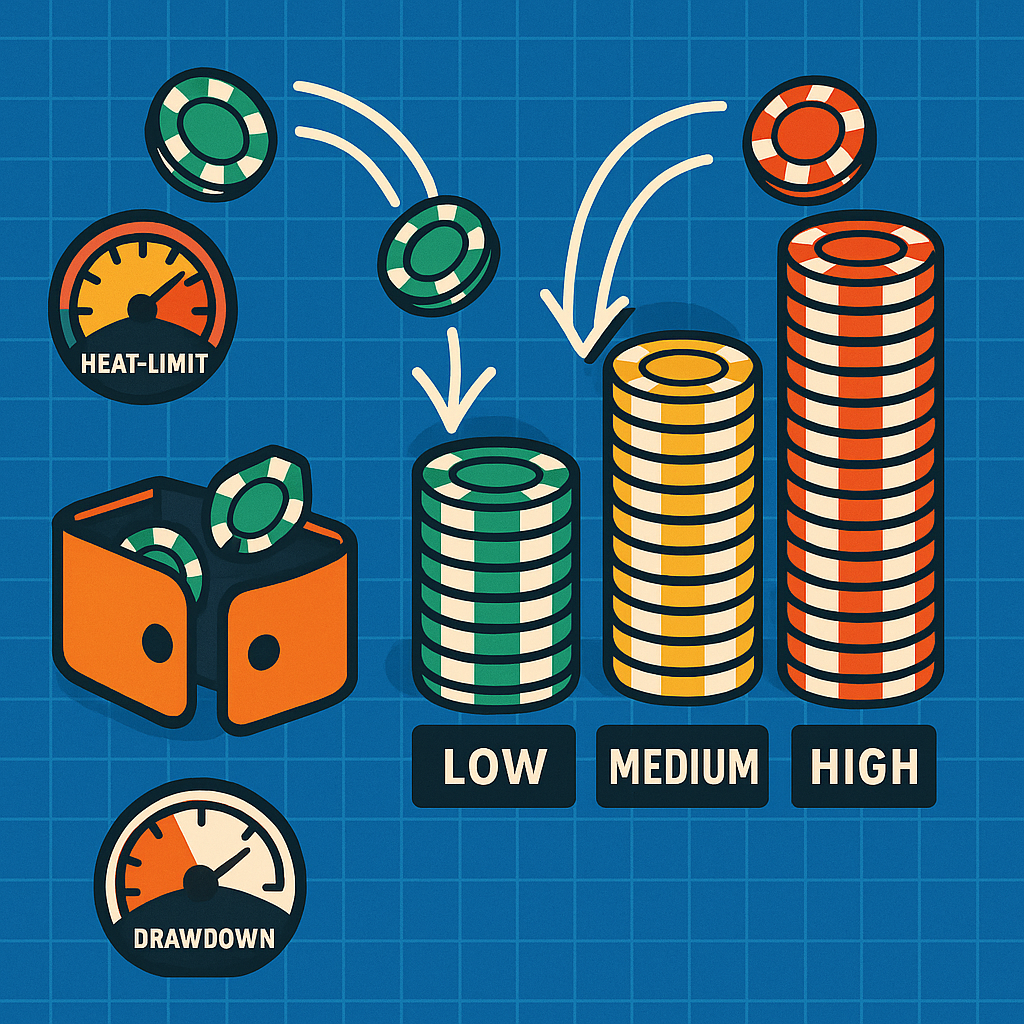
Table of Contents
-
Overview: Guardrails That Keep Drawdowns Small
-
Drawdown Math in Plain English
-
The Three-Layer Guardrail System
-
Sportsbetting: Parlay and Concentration Guardrails
-
Online Casino: Volatility Buckets, Session Caps, and Wallet Separation
-
Simple Tools, Rollout Plan, and One Smart CTA
-
Conclusion: Your Edge Survives Only If Your Bankroll Does
-
FAQ
Overview: Guardrails That Keep Drawdowns Small
Expert Insight:
According to unabated.com, Props+ Premium includes real-time game and prop odds screens and a Props Simulator that runs 10,000 simulations on your player projections to produce distributions and point-by-point fair prices, plus access to Massey-Peabody ratings and a DFS Pick ’Em Entry Builder ( Learn more: Science‑Backed Online Casino Techniques: Edges, Pace, and Safer Sessions. Learn more: Responsible Bankroll Session Controls: Practical Rules for Every Betting Session. Learn more: Myths vs Facts: Responsible Gambling and the House Edge Every Bettor Should Understand.
https://unabated.com/pricing
). (
unabated.com
)
Overexposure doesn’t show up as one bad bet—it shows up as drawdown. Guardrails are predefined rules that cap how much you can lose in a session, a day, or a month, and how much total risk you can carry at once. They stop tilt, prevent cascading losses, and keep your bankroll intact across every betting site you use. This approach works for sportsbetting, parlays, props, and even online casino sessions. For more details, see Bankroll-Safe Parlays: How to Use Sports Betting.
The idea is simple: define a base unit of risk, decide how much simultaneous exposure you’ll allow, and lock in stops that trigger automatically. No heroics, no guessing. Just a repeatable system that keeps you in action for the next slate of Games.
Drawdown Math in Plain English
Start with a base stake called 1R (your per-bet risk unit). For many bettors, 1R is 0.5%–1.5% of bankroll. Smaller R means smaller swings and lower risk of ruin.
-
Expected drawdowns happen
: Even with an edge, you’ll face 10–20R slides over long samples. Planning for that is the point.
-
Heat
is the sum of open risk across all active bets. Cap total heat at 3–5R to avoid a sudden equity dip if several positions lose together.
-
Hit rate and variance matter
: Even if your Projections are great, streaks will run against you. Build rules for the worst day, not the best.
Use this as your working BREAKDOWN: define R, cap heat, and enforce loss stops. A great rule of thumb: if you can’t survive a 15R drawdown without changing behavior, your R is too big.
The Three-Layer Guardrail System
These layers prevent one bad stretch from turning into a bankroll crisis. Treat them as a FEATURE, not a hassle.
-
Session loss cap
: Stop for the session at 2R lost (casino or in-play cluster for a single slate). No exceptions.
-
Daily loss cap
: Stop at 4R lost for the day. If hit, no more betting—even if you see a Featured number you love.
-
Rolling 30-day cap
: At 12R down over 30 days, trigger a hard reset: cut unit size by 50% and reduce heat limit by 1R until recovery.
-
Unit-size freeze
: If you’re down 6R from the last equity high-water mark, halve 1R automatically and keep it there until you regain half the drawdown.
-
Loss-brake ladder (1-2-3)
: After 1R down in a day, take a 30-minute pause; after 2R, quit for the slate; after 3R, stand down for 24 hours.
-
Giveback control
: If you’re up for the day, stop if you give back 40% of the day’s peak P&L. Protect wins; avoid churn.
Sportsbetting: Parlay and Concentration Guardrails
Sports markets can concentrate risk fast, especially around Featured lines and Props. Keep multipliers and correlations in check.
-
Singles first
: Most positions should be straight bets sized at 1R or less. Use parlays sparingly to avoid hidden correlation risk.
-
Parlay caps
: Limit total daily parlay risk to 1R and no single parlay above 0.5R. Cap max legs at 4 unless you’ve explicitly modeled correlation. No reloads after a parlay loss.
-
Correlation checks
: Don’t stack sides/totals/Props from the same game unless your model adjusts for dependence. If you do, count combined exposure toward heat. For College Football slates, Featured Games can dominate your card—set per-game caps (≤1R total across all markets).
-
Concentration limits
: Per event ≤1R, per league/day ≤5R. If you hit the league cap (NBA, NFL, College Football), stop adding new positions in that league.
-
Cross-book heat limit
: Across every betting site, keep total open risk ≤3–5R. Track it live; it’s your most important Premium discipline.
-
Projections and Props
: Use Projections to size edges and avoid overbetting thin spots. Treat alt lines and Featured Props as higher variance and size at half-R. If your tool has Props+ or Premium PACKAGES, use them to mark high-volatility markets and FEATURE guards in your workflow.
Online Casino: Volatility Buckets, Session Caps, and Wallet Separation
Casino variance is brutal. Apply stricter controls than in sports.
-
Volatility buckets
: Low (blackjack/baccarat), medium (video poker), high (most slots), ultra-high (jackpots). Size 1R for low, 0.5R for medium, 0.25R for high, and avoid ultra-high unless it’s entertainment-only at 0.1R.
-
Session limits
: 30–45 minutes or 2R loss—whichever comes first. If up ≥3R, lock 50% and stop on a 30–40% giveback from the session high.
-
Heat and time
: No more than one active game at a time. No chasing. If two sessions end red in a day, stop for 24 hours.
-
Wallet separation
: Maintain separate wallets for sportsbetting and online casino. No cross-subsidy. Treat your bankroll like a company ledger—clean, auditable, and consistent.
-
Tools and PACKAGES
: Many Premium PACKAGES that include Props+ style FEATURES or table-edge calculators run around $ 99 /mo; use them to estimate volatility and set appropriate R before you play.
Simple Tools, Rollout Plan, and One Smart CTA
Keep tooling lightweight so you actually use it.
-
Sheet
: Columns for date, bankroll, 1R, heat, session result, daily P&L, high-water mark, breaches, actions taken. Color cells when caps trigger.
-
Timer
: Use a phone timer for session caps and cool-offs. Feature alarms for 30-minute and 24-hour stand-downs.
-
14-day setup
: Days 1–3 set R and caps. Days 4–7 track heat across every site. Days 8–14 rehearse triggers: intentionally stop at 2R, freeze unit size at −6R from the peak, and log giveback stops.
-
90-day audit
: Compute max drawdown, average heat, frequency of stops, and ROI by market (sides, totals, Props, parlay). Tighten rules where breaches cluster.
If you need to diversify exposure, open one more
betting site
only after your heat and loss caps are live. More accounts without guardrails just magnify risk.
Conclusion: Your Edge Survives Only If Your Bankroll Does
Edges come and go; drawdowns are guaranteed. Guardrails—heat limits, loss caps, unit-size freezes, and parlay discipline—turn volatility into something you can withstand. Use Projections and Featured tools to find value, but let your rules decide how much to risk and when to stop. Build the system once, follow it every day, and your bankroll will be there when the next great number hits.
FAQ
Q:
I don’t have much betting history—how can I set initial guardrails that aren’t arbitrary?
A:
Start by defining a unit as 0.5–1.0% of your withdrawable bankroll. Use conservative defaults: session loss cap 2–3 units, daily cap 4–6 units, and rolling 30‑day cap 20–30 units. Run these for 30–90 days, then tune using your actual variance and hit rates.
Q:
What’s the simplest way to track “heat” across multiple books and live bets?
A:
Define heat as the total cash you’d lose if every open bet lost right now (parlays count at staked amount, not potential win; futures at current staked risk). Set a single heat cap as a percentage of bankroll (e.g., 8–12%) and don’t add new bets if the next click would exceed it. A one‑page sheet that auto‑sums open risk across books is enough if you update it before each wager.
Q:
Do bonuses, free bets, and credits count toward bankroll and guardrails?
A:
Your true bankroll is only cash you can withdraw today; that’s what all loss caps and drawdown bands reference. Value free bets at their expected cash value (typically 60–75% of face) when tallying exposure, but don’t let them inflate bankroll. Never include site credit or loans, and never let promos override your loss caps.
Q:
When should I increase unit size without blowing up risk controls?
A:
Only step up at a new high‑water mark after at least 30 days with no guardrail breaches. Raise units in small increments (about 10–20%), and never mid‑session or mid‑slate. If you’re more than 5–10 units off peak, freeze or step down sizing until you recover.
Q:
I hit my daily loss cap early but see a rare A+ edge—what now?
A:
Caps are hard stops. If you continue, only do so by re‑allocating: close or offset existing exposure so heat and daily loss stay inside limits. Alternatively, predefine a tiny weekly exception allowance (0.5–1 unit) tracked separately and deducted from tomorrow’s cap—no ad‑hoc overrides.
Related Reading
Bankroll Management Strategies for Sports Betting: Portfolio Control, Correlation Caps, and Cash Flow Discipline
Bankroll Sizing vs Risk Limits: Practical Rules for CLV‑Driven Scaling
Bankroll Regression Control: Avoiding Overexposure Without Arbitrage
Stake Sizing Inside Parlays: Caps That Prevent Multipliers From Blowing Up Risk
Round Robin vs SGP: Risk Control With Structured Multipliers
Value Betting Calculator: Kelly Criterion vs Fixed Stake
Sports Betting Bankroll Basics: Protect Your Bankroll Like a Pro