Key Takeaways
- Learn how to read American, decimal, and fractional odds so you can quickly understand how much you risk and how much you can potentially win on any bet slip.
- Get clear on the main bet types—moneyline, point spread, totals (over/under), parlays, and props—so you choose the simplest option that matches how you like to follow a game.
- Follow a step-by-step process to open an account, deposit safely, verify your identity, and place your first bet on a legal sportsbook website or app.
- Use basic bankroll rules—like setting a fixed budget, betting a small percentage per game, and avoiding chasing losses—to protect your money while you learn.
- Avoid common beginner mistakes such as betting on every game, overusing parlays, ignoring line movement, and betting with your heart instead of based on simple, objective info.
Table of Contents
- Overview: What Sports Betting Really Is (and Isn’t)
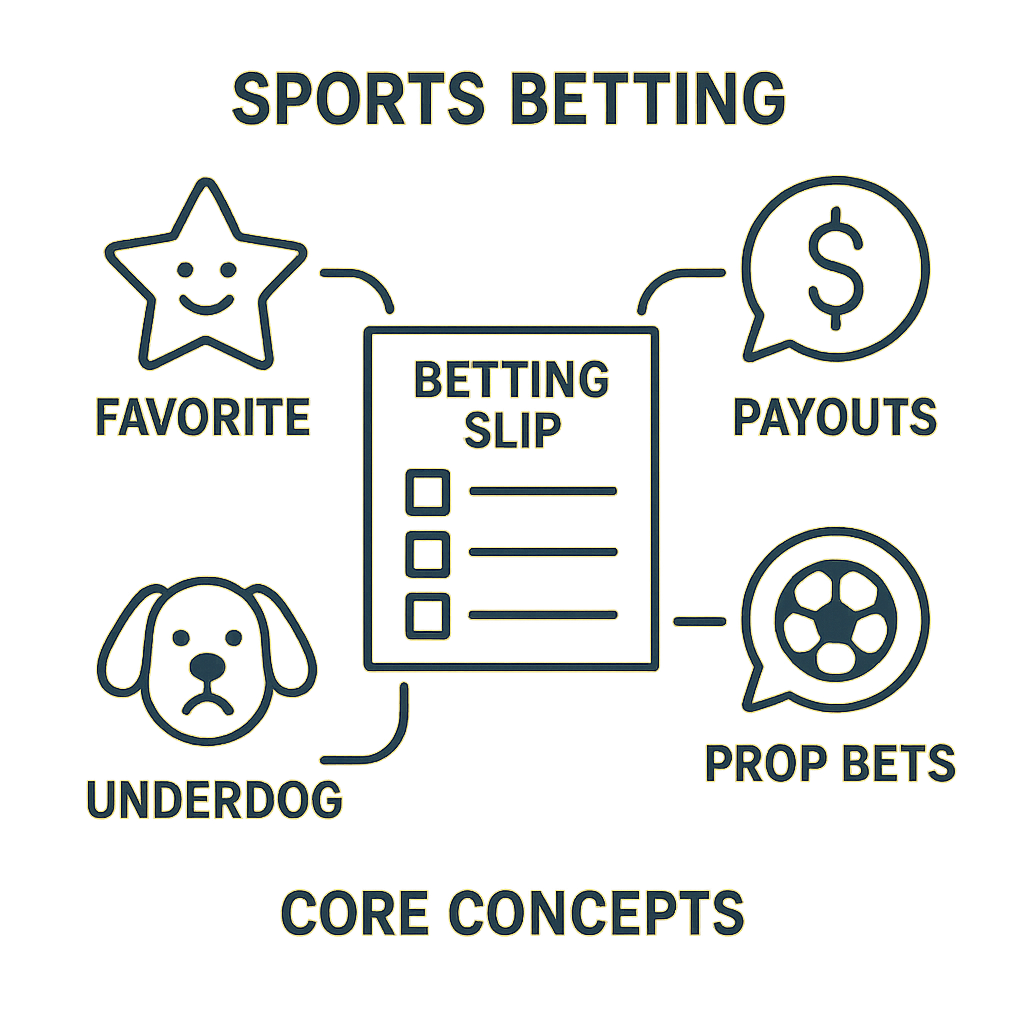
- Core Concepts: Odds, Favorites, Underdogs, and Payouts
- Main Bet Types: Moneylines, Spreads, Totals, Props, Futures, and Parlays
- From Signup to Slip: How to Place Your First Sports Bet Online
- How to Pick Smarter Bets: Simple Frameworks for Beginners
- Conclusion: Building Confidence in Sports Betting One Game at a Time
- FAQ
Overview: What Sports Betting Really Is (and Isn’t)
Expert Insight: According to Action Network, beginners should first understand that oddsmakers always designate a favorite (more likely to win, shown with a minus sign) and an underdog (expected to lose, shown with a plus sign), and that truly even matchups are listed as a “pick” or “pick’em” bet (https://www.actionnetwork.com/education/how-to-bet-on-sports-the-first-12-things-beginners-need-to-know). (www.actionnetwork.com)
If you are new to sportsbetting, the experience can feel confusing fast: numbers everywhere, strange symbols like -110 and +200, and endless menus for spreads, totals, props, and parlays. Underneath all that, though, sports betting is simple: you are making a prediction about what will happen in a game, agreeing on a price with the sportsbook, and risking money on that prediction.
This beginner guide focuses on the practical side of how to bet on sports, not just abstract theory. You will learn:
- How odds actually work and what they tell you about a team’s chances.
- The core bet types: moneylines, spreads, totals, props, futures, and parlays.
- How to read a betting screen on a modern betting site or app.
- Step‑by‑step how to place your first bet online.
- Beginner‑friendly ways to pick bets and avoid common traps.
This article is not about advanced models or pro‑level strategy. It is about getting you from “I have no idea what any of this means” to “I can confidently read a betting board, understand the risks, and place a bet I am comfortable with.”
Keep in mind that sportsbetting is gambling. You are paying for entertainment with the possibility of winning, not a reliable way to make money. If you treat it like a long‑term investment or a side job from day one, you are likely to be disappointed. Treat it like you would an online casino session or a night out: set a budget, expect swings, and stop when the budget is gone.
Core Concepts: Odds, Favorites, Underdogs, and Payouts
Before you place a single bet, you need to understand how odds work. Odds tell you two things at once:
- How likely the sportsbook thinks an outcome is.
- How much you win relative to how much you risk.
Modern betting sites usually default to American odds in the U.S., fractional odds in the U.K., or decimal odds in much of Europe and Canada. You can usually switch formats in your account settings. This guide focuses on American odds, since they are what most new North American bettors see first.
Favorites vs. underdogs
Every betting line starts with a favorite and an underdog:
- The favorite is more likely to win. It has a minus sign in front of the odds: -110, -150, -300, and so on.
- The underdog is less likely to win. It has a plus sign in front of the odds: +110, +200, +450, etc.
- When a game is considered a 50/50 toss‑up, you might see “PK” or “pick’em,” meaning neither side is clearly favored.
In practice, this looks like:
- Team A -150
- Team B +130
Team A is the favorite (minus sign), Team B is the underdog (plus sign). The numbers themselves show the price you pay or the amount you win.
How American odds translate to payouts
American odds are centered around winning or risking $100, but you can bet any stake you like. The rules:
- Negative odds (favorite, e.g., -150): the number shows how much you must risk to win $100.
- Positive odds (underdog, e.g., +200): the number shows how much you will win if you risk $100.
Examples:
- -150: You risk $150 to win $100 (total return $250). If you bet $30 instead, you win $20 (because 30 is 1/5 of 150).
- -110: You risk $110 to win $100. This is the most common price on point spreads and totals.
- +130: You risk $100 to win $130 (total return $230). If you bet $20, you win $26.
- +300: You risk $100 to win $300; a $10 bet wins $30.
Once you get used to the pattern, you can estimate payouts quickly without a calculator. Most apps also show the exact potential payout as soon as you enter a stake in the bet slip, so you can always double‑check.
Implicit probability: what odds say about chances
Odds also encode the implied chance of something happening. You do not need to do the math every time, but knowing the rough idea helps you avoid unrealistic expectations.
- -110 is roughly 52.4% implied probability.
- -150 is about 60%.
- +100 (even money) is 50%.
- +200 is about 33.3%.
- +400 is about 20%.
Notice how even solid favorites lose a lot. A -150 favorite, which many beginners assume is “safe,” still loses around 40% of the time in the long run. That is why you should not chase “locks” or build huge parlays out of heavy favorites thinking you have found a shortcut.
What is the “juice” or “vig”?
On many standard markets, you will see something like:
- Team A -3 (-110)
- Team B +3 (-110)
Both sides are -110 instead of +100. This difference is the “juice” or “vig” (short for vigorish). It is the sportsbook’s built‑in edge. Over thousands of bets, that juice is how the house makes money, just as an online casino relies on house edge in roulette or slots.
You cannot avoid juice entirely, but you can reduce its impact by:
- Comparing prices across multiple sportsbooks and betting sites (called “line shopping”).
- Avoiding overly exotic markets with very high vig.
- Not overpaying for convenience bets like pre‑built parlays that bundle many legs together at inflated prices.
Understanding odds, favorites, underdogs, and juice gives you the foundation to read any betting line you see, whether it is NFL point spreads, NBA totals, soccer moneylines, or tennis match odds.
Main Bet Types: Moneylines, Spreads, Totals, Props, Futures, and Parlays
Once you are comfortable with odds and favorites vs. underdogs, you can start exploring the main types of bets. Almost everything you see on a sportsbetting screen is a variation on these core markets.
1. Moneyline bets: just pick the winner
A moneyline bet is the simplest form of betting: you pick which team or player will win the game or match. Margin of victory does not matter.
Example:
- Dallas Cowboys -180
- New York Giants +150
If you bet Cowboys -180, you are risking $180 to win $100 (or $18 to win $10). If they win by any score, your bet wins. If you bet Giants +150, you risk $100 to win $150; they just need to win the game.
Moneylines are common in all sports, but especially in lower‑scoring games like baseball, hockey, or soccer, where point differentials are smaller and spreads are less central than in football or basketball.
2. Point spreads: betting on margin of victory
Point spreads even the playing field by giving or taking points from each team. Instead of betting “who wins,” you are betting “by how much.”
Example:
- Philadelphia Eagles -4.5 (-110)
- Detroit Lions +4.5 (-110)
If you bet Eagles -4.5, you need them to win by 5 or more for your bet to cash. If they win by 3, you lose. If you bet Lions +4.5, you win if the Lions either win the game or lose by 4 or fewer points.
Key details:
- The minus sign before the spread (e.g., -4.5) marks the favorite; the plus sign marks the underdog.
- Half points (like 4.5) prevent ties. When spreads are whole numbers (like -3), you can get a “push” if the margin lands exactly on the number, and your stake is refunded.
- Spreads are most common in the NFL, college football, NBA, and college basketball, but you will see spread‑style markets in other sports too, often called “run line” (MLB) or “puck line” (NHL).
3. Totals (over/unders): betting on combined points
Totals are bets on how many points, goals, or runs both teams will score combined, not who wins. The sportsbook sets a number, and you bet whether the actual total will be over or under that number.
Example:
- Total points: 46.0 (-110 over / -110 under)
If the final score is 27–20 (total 47), over 46 wins, under 46 loses. If the score is 24–17 (total 41), under wins. If the total lands exactly on 46, it is a push and your stake is refunded.
Totals appear everywhere:
- NBA game totals (often 210+ points).
- MLB totals (often 7.5 to 9.5 runs).
- NHL game totals (often 5.5 to 6.5 goals).
- Soccer totals (often 2.5 or 3.5 goals).
- Player totals (yards, points, assists, shots on goal, etc.).
4. Props: bets on players and specific events
Prop bets (short for proposition bets) focus on specific outcomes within a game rather than the final score. They can be player‑based or event‑based.
Common examples:
- Player props: a quarterback over/under 275.5 passing yards, a striker to score a goal, a basketball player over/under 7.5 assists.
- Game props: which team scores first, whether there will be overtime, total touchdowns, or number of corners in a soccer match.
- Novelty props: special markets for major events like the Super Bowl (coin toss, MVP, etc.).
Props are great for beginners who know their favorite players well and want to translate that knowledge into bets. Just remember that props often carry higher juice and more volatility than core markets like moneylines and spreads.
5. Futures: long‑term season bets
Futures are bets on events that will be decided over a longer time frame, like a full season or tournament.
Examples:
- Which team will win the Super Bowl, NBA Finals, World Series, or Stanley Cup.
- Who will win league MVP, Rookie of the Year, or Golden Boot in soccer.
- Season win totals: over/under on how many games a team will win over a season.
Futures usually offer higher odds because they involve more uncertainty and your money is tied up for longer. They are fun for fans who want a season‑long sweat, but you should not lock up large portions of your bankroll in futures if you are just starting out.
6. Parlays: combining multiple bets
A parlay is a bet that combines two or more individual bets (called “legs”) into a single ticket. For the parlay to win, every leg must win. If any leg loses, the entire parlay loses.
Example 3‑leg parlay:
- Celtics moneyline -200
- Lakers -4.5 spread -110
- Game total over 218.5 -110
If all three outcomes hit, you win a larger payout than if you had bet them individually. If just one misses, the parlay is dead. This trade‑off is why parlays are both popular and risky: the more legs you add, the more attractive the potential payout, but the lower the actual probability of success.
Sportsbooks and every betting site promote parlays heavily because the house edge multiplies as you stack legs. For beginners, parlays should be treated as occasional entertainment bets, not a primary strategy. It is very easy to underestimate how often a single small mistake in a long parlay will wipe out the whole ticket.
As you gain experience, you can explore more sophisticated parlay strategies, same‑game parlays, and multi‑sport combinations. Early on, keep them small and simple, and focus most of your bankroll on single‑game bets you understand well.
From Signup to Slip: How to Place Your First Sports Bet Online
Knowing the theory is only half the battle. The next step is understanding how to move around a real sportsbook or betting site, interpret what you see on the screen, and place your first bet without feeling overwhelmed.
1. Choose where you will bet
If you live in a region with legal online sportsbetting, you will typically have a choice among several licensed books, each with its own app and website. You can also walk into retail sportsbooks at casinos or stadiums, but most beginners start online.
When comparing options, look at:
- Licensing and safety: Stick with regulated books in your state or country. Avoid offshore or unlicensed sites.
- Sports and markets: Make sure they offer the leagues and bet types you care about (NFL, NBA, soccer, tennis, etc.).
- Odds quality: Once you are comfortable, you can compare lines across multiple sites to get better prices on the same bets.
- Ease of use: Clean navigation, fast bet slips, and clear account pages are important when you are learning.
If you are ready to explore a regulated operator, you can check out this betting site as a starting point and compare its interface and odds to other licensed books in your area.
2. Create your account and fund it carefully
Sign‑up usually requires:
- Basic personal info (name, date of birth, address, email).
- Identity verification (last four digits of your SSN in the U.S., or other ID checks depending on your country).
- Location verification (GPS or Wi‑Fi data to confirm you are in a legal betting jurisdiction).
For deposits, common options include:
- Debit cards and bank transfers.
- E‑wallets like PayPal or similar services, depending on your region.
- In‑person cash deposits at casino cages in some markets.
Before you deposit, decide on a total budget for sports betting that you can afford to lose without affecting bills, savings, or obligations. Treat it like a season‑long entertainment budget rather than money you “need” to win back.
3. Learn the layout of the betting screen
Most apps and sites have a similar structure:
- Top navigation: Sports categories (NFL, NBA, MLB, NHL, soccer, tennis, etc.).
- League view: A list of upcoming games with three primary columns: spread, moneyline, and total.
- Game detail page: Expanded markets like props, alternate lines, and same‑game parlay options.
- Bet slip: A side panel or pop‑up that appears when you tap or click on a bet; this is where you enter your stake and confirm.
On a typical game listing, you might see something like this (laid out horizontally):
- Team A -3.5 (-110) | -170 | O 47.5 (-110)
- Team B +3.5 (-110) | +145 | U 47.5 (-110)
From left to right, that is:
- Spread (Team A -3.5, Team B +3.5).
- Moneyline (Team A -170, Team B +145).
- Total (Over/Under 47.5 points).
As a beginner, focus on these three core columns. You do not need to dive into obscure props or complex parlay builders right away.
4. Building and confirming your first bet
Once you have chosen a game and a market, placing a bet is straightforward:
- Step 1: Select your bet
Tap or click on the odds next to the team or total you want. The selection will appear in your bet slip. - Step 2: Enter your stake
In the bet slip, type how much you want to risk. The app will automatically show your potential payout and potential profit. - Step 3: Check the details
Make sure you chose the correct side (favorite vs. underdog, over vs. under) and that the odds and line number (spread or total) are what you intended. - Step 4: Place the bet
Hit the “Place Bet” or “Confirm” button. Some books may ask you to confirm again if odds moved slightly. - Step 5: Track your bet
Your active bet will appear under “Open Bets” or “My Bets.” You can follow the game and see how your position is doing in real time.
Many sportsbooks also offer live betting, allowing you to bet as the game unfolds with constantly updating odds. Live betting is exciting but can lead to impulsive decisions, especially for beginners. It is wise to start with pre‑game bets until you are fully comfortable reading lines and managing your emotions.
5. Tickets, grading, and cashing out
After a game ends:
- The sportsbook “grades” your bet as a win, loss, or push.
- If you win, your stake plus profit is added back to your account balance automatically.
- If there is a push, your stake is refunded.
- If you lose, your stake was already deducted at the time you placed the bet.
Many modern sites also offer cash out on certain bets, letting you settle early for a locked‑in profit or reduced loss. For beginners, cash‑out can be helpful in managing nerves, but long term it tends to favor the house because the cash‑out prices usually include extra juice. Use it sparingly and only when you have a clear reason, not just fear of a late comeback.
How to Pick Smarter Bets: Simple Frameworks for Beginners
Once you know how to read odds and place bets, the big question becomes: what should I actually bet on? There is no magic formula that guarantees profit, but there are simple, practical frameworks that will keep you from making the most common beginner mistakes.
1. Start with leagues and teams you actually follow
You do not need to bet every sport. In fact, you probably should not. Your best chances of making informed decisions come from leagues you already understand well.
- If you watch the NFL every week, start there before you touch niche sports.
- If you are deeply into soccer, focus on specific leagues (Premier League, La Liga, MLS, etc.) that you follow closely.
- If you are an NBA fan, start with sides and totals before diving into exotic player props.
Specialization helps you interpret news, injuries, schedule spots, and style matchups that a casual fan might miss.
2. Use a simple pre‑bet checklist
Before placing any bet, run through a quick checklist so you are not just going off vibes or team logos:
- Injuries and lineups: Are key players missing or limited?
- Schedule and fatigue: Is this a back‑to‑back, long road trip, or short rest spot?
- Motivation: Does the game matter for playoffs, relegation, seeding, or is it a dead rubber?
- Playing style: Are these teams fast‑paced or slow, offensive or defensive?
- Weather (for outdoor sports): Wind, rain, snow, or extreme heat can impact scoring.
This does not guarantee a winning bet, but it filters out careless picks and forces you to have a real reason before risking money.
3. Be careful with big favorites and “sure things”
Beginners often gravitate to heavy favorites because “they almost can’t lose.” Odds like -300 or -500 look safe, but they carry hidden risk:
- You must risk a lot to win a little. A single upset can wipe out multiple previous wins.
- Big favorites lose more often than people think, especially late in seasons when motivations vary.
- Stacking big favorites into parlays does not make them safe; it multiplies your risk, not your edge.
A more sustainable approach is to:
- Limit how often you play huge moneyline favorites.
- Consider the spread instead if you believe the favorite will win comfortably.
- Be open to underdogs when the price seems generous relative to their real chances.
4. Respect variance: even good bets lose
In sportsbetting, outcomes are noisy. Bad beats, blown leads, and fluky endings are part of the game. This has two implications:
- Do not judge a bet solely by whether it won or lost. A smart, well‑reasoned bet can lose, and a reckless bet can win once.
- Avoid “tilt” or emotional chasing after a loss. Doubling your stakes to win back money quickly usually leads to bigger losses.
Instead, think in terms of many bets over time. Ask yourself, “If I made this exact bet 100 times in this exact situation, would I be happy with the price I am getting?” You will rarely know the true answer, but the question keeps you focused on process, not just results.
5. Keep records from day one
Most sportsbooks show your betting history, but it is worth keeping your own simple log. Record:
- Date and sport.
- Type of bet (moneyline, spread, total, prop, parlay).
- Odds and stake.
- Win, loss, or push.
- A short note on why you made the bet.
Over time, patterns will emerge:
- You might find you do better with spreads than props.
- You may notice that your biggest losses come from impulsive live bets.
- You might discover that your soccer totals perform better than your NBA sides.
Use those patterns to adjust your focus: double down on the areas where you are more consistent and scale back the ones where you routinely struggle.
6. Understand the role of analytics and expert picks
There is no shortage of data, models, and expert picks online. These can be useful, but they are tools, not guarantees:
- Odds already reflect a lot of public information: Injuries, basic stats, and major news are baked into the line quickly.
- Consensus picks (where most of the public is betting) are not automatically good or bad; they mainly show where casual money is going.
- Paid picks and touts should be approached with caution. No one can predict sports outcomes with certainty, and anyone promising guaranteed profit is not being realistic.
As a beginner, use previews, stats, and expert analysis to inform your own thinking, not to replace it. Read why someone likes a bet, then decide if the reasoning makes sense at the odds you are getting.
7. Keep parlays as a small, fun part of your action
Parlays deserve special mention because they are heavily marketed and extremely tempting. It is fine to play a parlay now and then for fun, especially to spice up a big game or weekend slate. Just keep these guardrails:
- Limit parlays to a small fraction of your total action.
- Keep the number of legs modest (for example, 2–4) rather than 8–10.
- Resist the urge to add “just one more leg” to chase a bigger payout.
- Avoid relying on pre‑built parlay suggestions from the book as your main bets.
Remember that every additional leg adds more juice and more ways to lose, even if all the individual picks look strong. Use parlays as occasional entertainment, not your default bet type.
Conclusion: Building Confidence in Sports Betting One Game at a Time
Learning how to bet on sports is less about memorizing every term and more about building a clear, repeatable routine. Once you understand odds, favorites, underdogs, and the main bet types—moneylines, spreads, totals, props, futures, and parlays—you can read any modern betting board without feeling lost.
From there, the key is discipline: choose a legal, trustworthy betting site, set a realistic budget, stick to sports and markets you understand, and use a simple pre‑bet checklist so you always have a reason for every wager. Expect swings, track your results, and avoid emotional decisions, especially after big wins or losses.
Above all, treat sportsbetting the same way you would an online casino night or entertainment expense: something you do for fun, not a guaranteed income stream. If you keep that perspective and apply the practical steps in this guide, you will give yourself the best chance to enjoy the action, learn as you go, and make smarter decisions every time you open a betting app or walk up to a sportsbook window.
FAQ
Q: What’s the simplest type of sports bet for a beginner?
A: The moneyline is usually the easiest place to start. You just pick which team or player will win the game or match, and the odds tell you how much you can win if your pick is correct.
Q: How much money should I start with when betting on sports?
A: Start with a small, fixed amount of money that you’re comfortable losing, often called a bankroll. Many beginners use flat bets, like 1–2% of their bankroll per wager, to avoid going broke on a few bad results.
Q: What’s the difference between fractional, decimal, and American odds?
A: All three formats describe the same thing: how much you can win relative to your stake. American odds use plus/minus numbers (like -150, +200), decimal odds show total payout per unit (like 1.80, 2.50), and fractional odds show profit vs. stake (like 4/5, 3/1).
Q: Should I use a betting app or a desktop site as a beginner?
A: Use whichever feels clearer and easier to navigate for you, but many beginners find desktop better for learning because more information fits on the screen. Once you’re comfortable with odds and bet types, betting apps are convenient for quick, game‑day decisions.
Q: How do I avoid common beginner mistakes when betting on sports?
A: Avoid chasing losses, betting on too many games at once, or wagering just because a game is on TV. Instead, compare odds, stick to your bankroll plan, and only bet when you understand the matchup, the odds, and the type of bet you’re placing.