Key Takeaways
- Compare parlay odds across multiple sportsbooks and calculate implied margins to see which book takes the smallest cut on multi-leg bets.
- Read each site’s parlay rules carefully, especially how they handle voided legs, pushes, and correlated bets like same-game parlays, because these can drastically change your expected value.
- Evaluate same-game parlay pricing tools and odds boosts to ensure they offer genuine value instead of inflated margins disguised as convenience features.
- Factor in all fees and hidden costs—including withdrawal fees, currency conversion, and minimum bet or leg requirements—before deciding where to deposit.
- Judge promos, bonuses, and loyalty programs by their realistic long-term ROI (wagering requirements, max win limits, and eligible markets) rather than just the headline bonus amount.
Table of Contents
- Why Does Parlay Value Change So Much From One Betting Site to Another?
- How Can You Measure Parlay Margins and Payout Differences Across Betting Sites?
- What Parlay Rules, Limits, and Voiding Policies Should You Compare Before Depositing?
- How Do Same-Game Parlays and Player Props Change the Way You Should Compare Sites?
- How Should You Factor in Bonuses, Promos, and Online Casino Offers When Comparing Parlay Value?
- What Hidden Fees, Banking Costs, and Operational Frictions Can Eat Into Parlay Profits?
- How Can You Use ROI, Bankroll Management, and Long-Term Tracking to Choose the Best Parlay Sites?
- What Practical Checklist Should You Use When Choosing a Betting Site Specifically for Parlays?
- FAQ
Why Does Parlay Value Change So Much From One Betting Site to Another?
Expert Insight: According to www.covers.com, BetMGM is recommended for NFL parlays because its user-friendly parlay builder lets bettors create up to 10-leg parlays or choose from pre-packaged same-game parlays with enhanced odds, all via its mobile app (https://www.covers.com/betting/parlay-betting-sites). (www.covers.com)
Two betting sites can post the same games and props but offer very different payouts on the same parlay. That difference isn’t random – it comes from how each sportsbook handles margins, parlay rules, and risk. If you ignore those details, you’ll routinely leave value on the table.
Every sportsbook is balancing two goals: attracting customers with appealing odds and protecting itself from sharp bettors and correlated outcomes. Parlays – including same-game parlays (SGPs) – are especially sensitive to how a book sets its internal pricing and limits. Some operators push parlays hard with flashy boosts and “quick picks,” while quietly baking in larger margins.
When you compare sites with parlay value in mind, you’re not just choosing a place to bet; you’re choosing a long‑term pricing environment. Over hundreds of tickets, small differences in odds, rules, and fees compound into a big gap in your results.
This guide focuses specifically on how to compare betting sites for parlay value – not just who has the slickest app or biggest welcome bonus. You’ll see how to:
- Measure parlay margins rather than trusting advertised boosts.
- Read the fine print on parlay rules, voids, and maximum legs.
- Evaluate same-game parlay pricing versus traditional multi‑game parlays.
- Account for fees, limits, and promos in your long‑term ROI.
- Decide when an online casino–style offer is worth using for sportsbetting parlays.
Once you understand these levers, you can treat each betting site as a pricing tool – using the one that consistently gives your parlays the best expected value instead of locking into a single brand out of habit.
How Can You Measure Parlay Margins and Payout Differences Across Betting Sites?
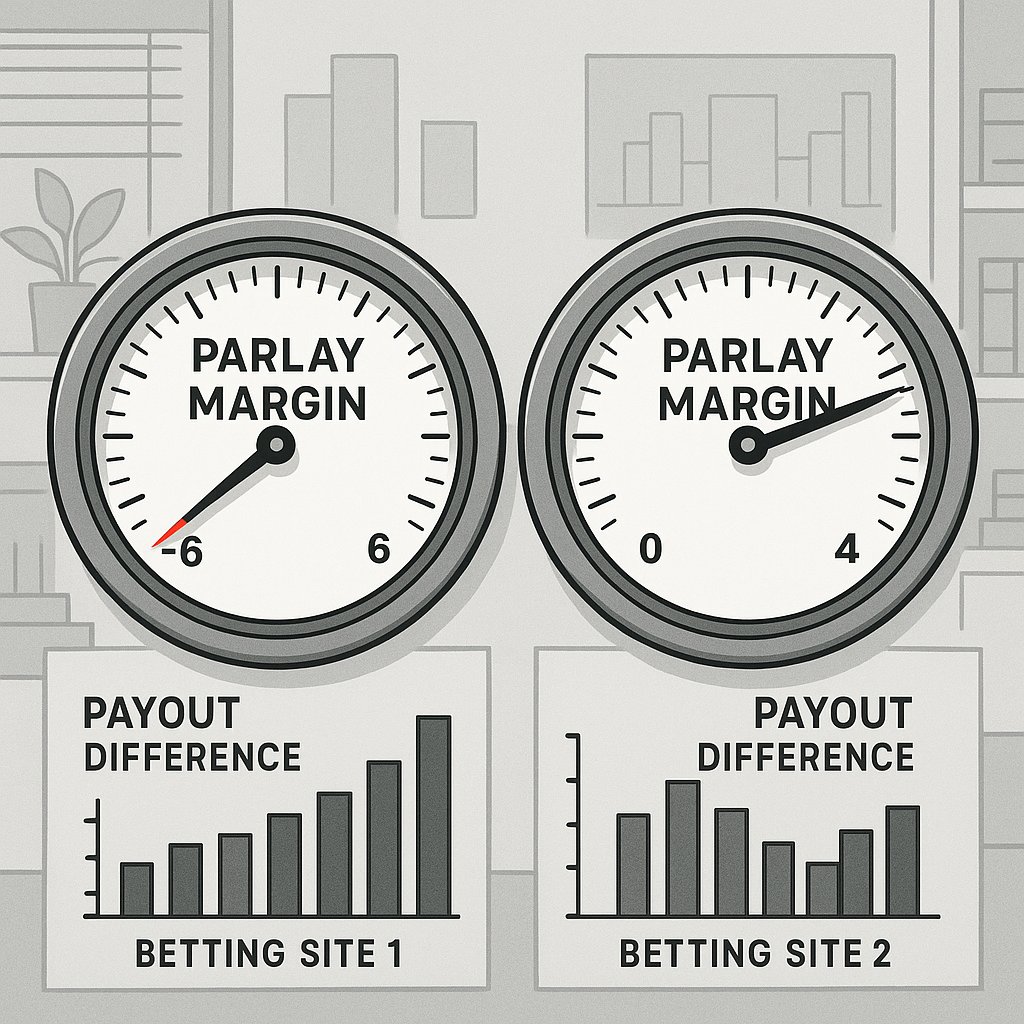
Parlay value starts with basic pricing. Before you think about bonuses or parlay builders, you need to know how expensive a sportsbook’s odds are. That “price” is the margin (or vig) built into every line.
The simplest way to compare parlay value across betting sites is to:
- Pick a few standard markets
Focus on lines that exist everywhere – for example, NFL sides and totals around -110, or mainstream soccer Asian handicaps and totals. These are easy to compare and heavily bet, so they reveal how aggressive or conservative a book is. - Convert odds to implied probability
For American odds, the rough logic is:
– For -110, implied probability ≈ 52.38%
– For +110, implied probability ≈ 47.62%
When you add the implied probabilities of both sides of a market (e.g., -110 / -110), anything above 100% is the bookmaker’s margin. Two -110 sides add to roughly 104.76%, implying about a 4.76% hold on that market. - Compare how those margins stack in parlays
Each leg’s margin piles into a parlay. Roughly speaking, if each leg is priced at -110 instead of true 50/50, the more legs you add, the more the hidden cost grows. If one betting site routinely hangs -107 or -105 instead of -110, your multi‑leg parlay will be significantly cheaper there. - Build the same parlay at 2–3 sportsbooks
Take identical legs (same sides, same prices where possible) and plug them into parlay builders at several betting sites. Record:
– Individual leg odds
– Total parlay odds
– Potential payout for the same stake
The site that pays the most for the same combination is giving you better parlay value – assuming all rules are equal. - Check how odds change as you add legs
Some operators quietly adjust internal pricing on larger parlays or SGPs. If you see the same three legs pay out very differently compared to the theoretical product of the individual prices, the book is likely managing extra margin on your combination.
If you’re more advanced, you can track implied hold over time. For example:
- Log 10–20 common NFL spreads/totals each week across a few books.
- Calculate average margin on those markets.
- Note any consistent edge: maybe one operator is 3–5 cents better on totals, another on player props.
Then, when you build parlays centered on those markets (like NFL props or soccer Asian handicap combos), you know which betting site is structurally better. Over a season, picking the lower‑margin book for your parlays can make a bigger difference than chasing occasional boosts.
What Parlay Rules, Limits, and Voiding Policies Should You Compare Before Depositing?
Two parlays with the same legs and odds can behave very differently depending on how each bookmaker handles rules. Before you deposit, you want to know exactly how a site treats leg limits, voids, pushes, and correlated outcomes.
Key rule areas to compare across betting sites include:
- Minimum and maximum legs
Most mainstream sportsbooks allow 2–10 leg parlays, but there are differences:- Some cap parlays at 10 legs; others go higher but may restrict stakes.
- Same-game parlays often have lower leg caps than multi‑game parlays.
- Books may limit how many player props or derivative markets you can include.
Check the terms or parlay builder interface so you’re not surprised when a certain combination is “not allowed.”
- How pushes and voids are handled
This is crucial for spreads, totals, and player props:- Does a push (like a spread landing exactly on the number) void the entire parlay or simply drop that leg and reprice the rest?
- How are postponed or abandoned games treated – immediate void, wait for reschedule, or graded after a set time window?
- Are voided legs removed from profit boosts or promos, reducing your benefit?
A bettor‑friendly site usually treats a push as “no action,” recalculating your parlay with one fewer leg.
- Restrictions on correlated parlays
Books don’t like parlays where legs are strongly correlated (for example, a team -7 plus their quarterback over passing yards in the same game). Typical rules:- Traditional parlays may ban certain combinations outright.
- Same-game parlay builders may price these combinations with extra margin to protect the house.
- Some markets – like alternate spreads, player milestones, or same‑drive props – may be completely excluded from parlays.
Read the SGP rules carefully so you know which types of correlations are allowed and how they’re priced.
- Maximum payouts and stake limits
Big parlay odds don’t matter if the site caps what you can win:- Check daily or per‑bet maximum payout limits; some books cap winnings by sport or market.
- Look for notes on “exotic” or long‑shot parlays; sometimes max stakes are very small.
- Note whether limits are lower on niche sports or player props versus major leagues.
If you’re building large‑odds parlays or same‑game parlays with big plus prices, you want a betting site that doesn’t choke your upside with low win caps.
- Cash-out rules for parlays
Many sportsbooks now let you cash out parlays mid‑game or between legs. Compare:- Which markets and parlay types are eligible.
- Whether partial cash‑out is offered or only full cash‑out.
- How fair the cash‑out offers look compared to live odds at other sites.
Cash‑out is not free money; it’s another pricing decision by the book. Still, a flexible, transparent cash‑out policy can add strategic options when your parlay is deep into the legs.
Before you move bankroll to a new operator, read their house rules and parlay pages, not just the marketing banners. The site with slightly worse odds but much more generous void and push rules can sometimes be the better choice for specific parlay styles.
How Do Same-Game Parlays and Player Props Change the Way You Should Compare Sites?
Same-game parlays (SGPs) and player prop parlays are where sportsbooks diverge the most in pricing and rules. Many bettors focus on the flashy front‑end – slick SGP builders, quick‑pick menus, and pre‑packaged combos – instead of the underlying value. That’s a mistake.
To compare SGP and prop parlay value across betting sites, focus on these factors:
- Depth and variety of SGP markets
Top operators usually offer:- Standard sides and totals.
- Basic player props (yards, receptions, points, shots on goal, etc.).
- Alternate lines and milestones.
Some books go further with:
- Micro‑markets (next drive result, next basket scorer, etc.).
- More niche stats (tackles, passes completed, shots on target).
The more markets available, the more flexibility you have to build correlated but still fairly priced parlays – if the odds are competitive.
- Quality of baseline prop pricing
SGP value starts with the standalone prop odds. If a site consistently hangs -125 where others are -115, your same-game parlay will be expensive even before correlation and extra margin are applied. Sample a few NFL prop bets or NBA player lines across major operators and see who’s consistently sharper. - How correlation is priced in SGPs
In a traditional multi‑game parlay, the book multiplies independent leg odds. In SGPs, the same simple multiplication would often underprice the risk because legs are correlated. Books adjust for this by:- Restricting certain combinations.
- Embedding a correlation premium in the SGP engine.
To gauge how aggressive that premium is, compare:
- Price of each leg individually.
- Theoretical “naive” parlay price (multiplying those legs as if they were independent).
- Actual SGP payout.
If the SGP payout is dramatically worse than the naive product, that site is charging you heavily for correlation.
- Same-game parlay promos and boosts
Many sportsbooks promote SGPs with insurance, free bets, or odds boosts. When comparing betting sites, ask:- Are boosts applied to the true parlay price or a reduced SGP engine price?
- Is the insurance (like “one leg can lose”) capped at a small stake?
- Do free bets from these promos have restrictive rollover or odds requirements?
A site that offers frequent, transparent SGP promos with reasonable caps can offset higher margins. But if boosts are rare or tiny, you should demand sharper baseline pricing.
- Ease of building and tracking SGPs
For regular SGP bettors, interface matters more than you might think:- Can you quickly toggle between legs and see live updated odds?
- Does the builder clearly explain why certain combos are blocked?
- Is it easy to save and reuse common parlay templates (for example, QB + WR + team spread)?
These usability factors don’t change the math, but they do influence how efficiently you can find and exploit value.
Player prop parlays outside of SGPs deserve similar scrutiny. Books often apply higher holds to props, then stack that into parlays. If your style leans heavily on props – NFL receiving yards, NBA points + rebounds, soccer shots on target – you should be even more selective about which betting site you use, because margin differences are magnified in multi‑leg combos.
How Should You Factor in Bonuses, Promos, and Online Casino Offers When Comparing Parlay Value?
Welcome bonuses, odds boosts, and cross‑promos from an online casino can materially change your effective parlay value – but only if you understand the fine print. When you compare sportsbooks for parlay use, it’s not enough to look at the headline offer; you need to translate offers into expected value and long‑term impact.
Key questions to ask about bonuses and promos:
- Is the welcome bonus cash or bonus bet credit?
Cash bonuses are usually more valuable. With bonus bets/free bets:- You often keep only the winnings, not the stake.
- They may need to be used on minimum odds (for example, +100 or longer).
- They may have short expiry windows.
For parlay-specific use, check whether the bonus bet can be applied to multi‑leg tickets and whether there’s a cap on potential winnings.
- Are there recurring parlay boosts or insurance offers?
Ongoing promos can matter more than one‑time bonuses. Look for:- Weekly parlay profit boosts (like +20% on 3+ leg parlays, up to a set max).
- SGP insurance (get stake back if one leg loses, often as bonus credit).
- Sport‑specific boosts (for example, NFL SGP boosts every Sunday).
Compare how often these are offered, the maximum qualifying stake, and any restrictions on eligible markets.
- What are the rollover and wagering requirements?
If a bonus or free bet requires you to roll over funds multiple times, your parlays will be exposed to more house edge. Be wary of:- High rollover (for example, 5–10x) that forces excessive volume.
- Restrictions that exclude your preferred parlay markets from contributing to rollover.
- Hidden conditions around cashing out early on promo-boosted parlays.
For serious bettors, a smaller, cleaner bonus with low rollover can be more attractive than a massive headline offer with harsh terms.
- How do online casino cross‑promos affect your sportsbetting?
Many operators run both an online casino and sportsbook. You might see:- Casino play unlocking sports free bets or parlay boosts.
- Sports parlays earning casino free spins or bonus balance.
- Shared loyalty points across both products.
These can be positive if you already play both, but they can also nudge you into higher‑edge casino games. From a parlay perspective, treat casino-derived free bets as a way to take shots at high‑variance, higher‑odds parlays without risking core bankroll. Just don’t let casino promos push you into chasing losses.
- Is there a loyalty or VIP program that rewards parlays?
Some books award extra points for parlays or props. Over time, those points can translate into:- Cashback or profit boosts.
- Free bets you can allocate to bigger parlays.
- Better customer service or higher limits.
When you compare two betting sites with similar odds but different loyalty structures, the one with more generous parlay rewards may be better for high‑volume multi‑leg bettors.
Think of promos as a temporary overlay on top of the underlying pricing. Good bonuses can justify using a slightly higher‑margin book for a limited time, but once the promo value is exhausted, you should revert to whichever sportsbook offers the best raw parlay odds and rules.
What Hidden Fees, Banking Costs, and Operational Frictions Can Eat Into Parlay Profits?
Even if you pick a sportsbook with sharp parlay odds, you can still lose value through fees and operational friction. When comparing betting sites, look beyond the betting markets and into how money moves in and out of the platform.
Important cost areas to evaluate include:
- Deposit and withdrawal fees
Most reputable betting sites don’t charge explicit deposit fees, but there are exceptions and indirect costs:- Third‑party processors (like certain e‑wallets or cards) may add their own fees.
- Some sportsbooks pass on fees for specific methods or small withdrawals.
- Currency conversion can bite if your bank account and betting site operate in different currencies.
If you’re making frequent deposits or cashing out small parlay wins often, these charges add up and effectively reduce your ROI.
- Payout speed and reliability
Slow or inconsistent payouts don’t change your theoretical parlay edge, but they affect your bankroll efficiency and risk management:- Fast payouts let you move funds to whichever betting site is offering the best parlay value at a given time.
- Delayed or disputed withdrawals can trap your bankroll, forcing you to keep betting at a sub‑optimal operator.
- Look for clear timelines and a track record of on‑time payments.
Reviews from established outlets can help verify whether payout speeds match what the marketing claims.
- Minimum bet sizes and withdrawal thresholds
For smaller bankrolls or cautious bettors:- High minimum bet sizes can push you into over‑staking your parlays.
- High minimum withdrawal amounts can keep small profits locked on the site.
- Fees for too‑frequent withdrawals can penalize disciplined cash‑outs.
Ideally, you want low minimum stakes and reasonable withdrawal thresholds so you can size parlays correctly and extract profits as you go.
- Account verification and document friction
Regulated sportsbooks must verify identity, but the process quality varies:- Some operators complete KYC quickly and only ask for extra documents in specific cases.
- Others routinely demand multiple documents at withdrawal, creating delays.
- Poor customer support can turn simple checks into week‑long waits.
Before you ship serious bankroll, make sure the betting site has a reputation for smooth verification and responsive support.
- Operational quirks that affect parlay strategy
Some non‑obvious features can influence your parlay experience:- Frequent odds changes without clear indication in the betslip may lead to mispriced legs.
- Limited live markets or unstable live platforms can hurt in‑play parlay builders.
- Site downtime or app crashes around big events can prevent you from hedging or cashing out.
These aren’t “fees” in the strict sense, but they are frictions that can reduce the practical value you get from a sportsbook.
When you compare betting sites holistically, combine the pure betting metrics (margins, rules, markets) with the financial and operational realities. The best parlay site for you is the one that delivers solid odds, fair policies, and inexpensive, reliable money movement.
How Can You Use ROI, Bankroll Management, and Long-Term Tracking to Choose the Best Parlay Sites?
Comparing betting sites for parlay value isn’t a one‑time decision. It’s an ongoing process that should be informed by your own data. You don’t need advanced math; you just need consistent tracking and a basic understanding of ROI and risk.
Here’s how to bring structure to your comparison:
- Define your parlay profile
Before you judge sites, clarify how you actually bet:- Do you prefer 2–3 leg parlays with moderate odds, or 6–10 leg long shots?
- Are you focused on sides and totals, or player props and SGPs?
- Do you bet mostly pre‑game, live, or a mix of both?
Different sportsbooks excel in different niches. A site that’s excellent for short, low‑margin NFL parlays might be mediocre for same‑game player prop ladders.
- Track bets by site, sport, and parlay type
Set up a simple log (spreadsheet or app) with fields like:- Sportsbook name.
- Stake, odds, and legs in each parlay.
- Sport and market types (sides, totals, props, SGPs, etc.).
- Result and payout.
Over 50–100 parlays per site, you’ll start to see patterns in how you perform and how often you’re getting good prices versus mediocre ones.
- Calculate ROI by sportsbook
Basic ROI is:
ROI = (Total Winnings – Total Stakes) / Total Stakes
Compute this separately for each betting site. Even if your sample is noisy, clear gaps (for example, -15% at one book vs. -5% at another) tell you something about pricing quality and fit with your style. - Note where promos actually move the needle
In your log, mark bets that used:- Welcome bonuses or bonus bets.
- Parlay boosts or SGP insurance.
- Loyalty rewards or free bets from an online casino cross‑promo.
Then calculate ROI with and without promo-related value. This shows whether a sportsbook is only competitive when a promo is active, or whether its baseline odds are solid enough to justify regular parlay use.
- Adjust bankroll allocation based on value
Once you see which betting sites are consistently giving you better parlay results (after accounting for variance), shift more of your active bankroll there. That doesn’t mean closing other accounts; it means prioritizing the operators where:- Margins are lower on your preferred markets.
- Parlay rules and pushes are favorable.
- Promos and loyalty rewards align with your volume.
At the same time, maintain basic bankroll discipline: fixed unit sizes, caps on total risk per day or week, and clear boundaries on how much of your roll you’ll allocate to parlays versus singles.
As you refine your approach, it often makes sense to maintain accounts at multiple sportsbooks. That way you can:
- Shop for the best individual leg prices before building a parlay.
- Use one site for sharper sides/totals, another for prop-heavy SGPs.
- Rotate where you deploy free bets or profit boosts for maximum impact.
If you’re ready to put this into practice, you can start by opening an account at a major, reputable betting site with a wide parlay menu via this sportsbook signup link, then compare its pricing and rules against at least one or two others over the first few weeks of betting.
Over time, your own tracked results become the most reliable guide. Instead of guessing which operator is “best,” you’ll know which ones actually deliver the strongest parlay value for your specific sportsbetting style.
What Practical Checklist Should You Use When Choosing a Betting Site Specifically for Parlays?
To turn all of this into action, it helps to have a concise checklist you can run through whenever you evaluate a new betting site for parlay use. Use the points below as a pre‑deposit filter.
1. Core pricing and markets
- Are standard spreads/totals close to -110 or better on major sports?
- Do they offer a deep menu of props and same‑game parlay markets for your primary leagues (NFL, NBA, soccer, etc.)?
- How do their odds on your favorite props compare with at least one other sportsbook?
2. Parlay rules and limitations
- What are the minimum and maximum number of legs for regular parlays and SGPs?
- How are pushes and voids handled – does the parlay continue with adjusted odds, or is the entire ticket voided?
- Which markets are excluded from parlays or same-game combinations (for example, certain props, in‑game markets, or highly correlated outcomes)?
- Are there clear, public house rules that explain these policies?
3. Payout caps, limits, and cash-out
- Is there a maximum payout per bet or per day that could affect your long‑shot parlays?
- Are stakes limited on certain high‑odds parlay types?
- Does the site offer flexible cash‑out on parlays and SGPs, and does it work reliably during peak events?
4. Bonuses, promos, and loyalty
- Is the welcome offer compatible with parlay betting (for example, bonus bets that can be used on multi‑leg tickets)?
- Are there recurring parlay boosts, SGP insurance offers, or sport‑specific parlay promos?
- Does the loyalty/VIP program reward parlays or higher‑odds bets with better point multipliers or perks?
- If the operator also runs an online casino, are there cross‑promos that meaningfully benefit your sportsbetting without pushing you into games you don’t want to play?
5. Banking and operational factors
- Are deposit and withdrawal methods low‑fee and convenient in your region?
- What is the typical payout speed, and are there user reviews backing that up?
- Are minimum bet sizes low enough for you to scale parlay stakes responsibly?
- Is customer support responsive in case you have a grading or payout dispute on a complex parlay?
6. Personal fit and long-term tracking
- Does the interface make it easy to build, edit, and review multi‑leg tickets?
- Can you easily see how odds changes affect your total parlay price?
- After a trial period, what does your ROI look like on parlays at this site versus others, controlling for variance as best you can?
If a potential sportsbook scores well across these categories, it’s a strong candidate for your parlay action. If it fails on multiple fronts – high margins, restrictive rules, weak promos, or clunky banking – you’re better off keeping your bankroll at operators that support your betting strategy rather than fight against it.
The goal isn’t to find a “perfect” betting site, but to systematically compare your options so that every parlay you place is as fairly priced and well‑supported as possible. With a disciplined approach to margins, rules, and fees, you can tilt the long‑term math of parlays as far in your favor as the market allows.
FAQ
Q: What’s the quickest way to compare parlay value between two betting sites?
A: Pick the same parlay on both sites (same legs, same odds format) and compare the combined payout. The book that pays more for the identical parlay is offering better value, especially if this pattern holds across multiple test parlays.
Q: How do I spot hidden margins in parlay odds?
A: Convert each leg’s odds into implied probability, multiply them together, then convert back to a fair parlay price and compare it to what the book offers. The bigger the gap between the fair price and the listed price, the higher the margin the site is taking on your parlay.
Q: Which parlay rules should I check before signing up with a betting site?
A: Look at how the book handles pushes, voided legs, correlated plays, and maximum number of legs. Rules on how parlays are graded in rainouts, cancellations, and player injury situations can significantly change your long-term returns.
Q: Are same-game parlays usually better or worse value than regular parlays?
A: Same-game parlays often have higher margins because the book controls what combinations are allowed and how they’re priced. Compare an SGP builder’s payout to manually combining similar legs across different games to see if you’re paying a premium for the convenience.
Q: How should promos and fees factor into choosing a site for parlay betting?
A: Boosts, profit multipliers, and parlay insurance can offset higher margins, but only if you can use them regularly on bets you’d place anyway. Also compare deposit/withdrawal fees and limits, because high transaction costs can quietly eat into your parlay profits over time.