Table of Contents
- Overview: Why RTP Myths Cost Players Real Money
- RTP Basics: What “96%” Actually Means in Math, Not Marketing
- Myth vs Fact: Common RTP Misconceptions Players Still Believe
- Slots at 96% RTP: What Happens Over 10,000 Spins
- Blackjack and Video Poker: Why RTP Depends on You
- Variance and Volatility: Why 10,000 Bets Still Is Not “Guaranteed”
- RTP Across Slots, Blackjack, Video Poker, and Sports Betting
- Bankroll, Bet Size, and 10,000-Spin Reality Checks
- Using RTP Smartly at Online Casinos and Betting Sites
- FAQ: Online Casino RTP Myths vs Facts
- Conclusion: Treat RTP as a Compass, Not a Promise
Overview: Why RTP Myths Cost Players Real Money
Expert Insight: According to www.casino.org, not all slot machines are equally favorable to players, and understanding Return to Player (RTP)—how it’s calculated and how it affects your odds—is the key factor that helps you choose higher-RTP slots and avoid becoming “slot machine fodder” (https://www.casino.org/blog/return-to-player-decoded/). (www.casino.org)
Return-to-Player (RTP) sounds simple: a slot advertises 96% and players assume they will get $96 back for every $100 they bet. In reality, that number is a long-run statistical expectation built on millions of spins, not a guarantee for your next session.
Across casino education sites like Casino.org, Casino Professor, and others, one theme keeps coming up: players consistently misunderstand how RTP works and how long it takes for results to resemble the advertised percentage. This misunderstanding is even more dangerous online, where you can spin or deal hundreds of hands in minutes.
This article cuts through the noise. You will see what 96% RTP really looks like over 10,000 bets on slots, blackjack, and video poker, which myths are wrong, and how to use RTP alongside volatility and bankroll management when you play at an online casino or a hybrid sportsbetting and casino betting site.
RTP Basics: What “96%” Actually Means in Math, Not Marketing
RTP (Return-to-Player) is the long-term percentage of total wagered money that a game is designed to pay back. If a slot has 96% RTP, the game math is built so that, across an extremely large number of spins, it keeps 4% (the house edge) and returns 96% to players in the form of wins and jackpots.
Key points:
- RTP is long-run: Online casino and land-based slot RTP is calculated over millions or even billions of simulated spins; your 500-spin session is a tiny sample.
- RTP includes all outcomes: Base-game hits, bonus rounds, jackpots, and free spins are all part of that percentage.
- RTP is theoretical: Actual results deviate around that number due to variance, especially in high-volatility games.
A quick comparison by typical RTP ranges, aligning with figures you will see on sites such as Casino.org and Casino Hawks:
- Online slots: ~94%–98% RTP, with many “good” titles around 96%
- Video poker: ~95%–99.5% depending on pay table and player skill
- Blackjack: ~99%+ with optimal play; much worse with errors
The house edge is simply 100% minus RTP. A 96% slot has a 4% house edge; a 99.5% video poker game has a 0.5% house edge. Understanding that small gap is critical when you project outcomes over 10,000 spins or hands.
Myth vs Fact: Common RTP Misconceptions Players Still Believe
Guides from sources like Havok Journal, SlotWizards, and BettingUSA repeatedly highlight the same myths. Here are the big ones that directly affect your bankroll.
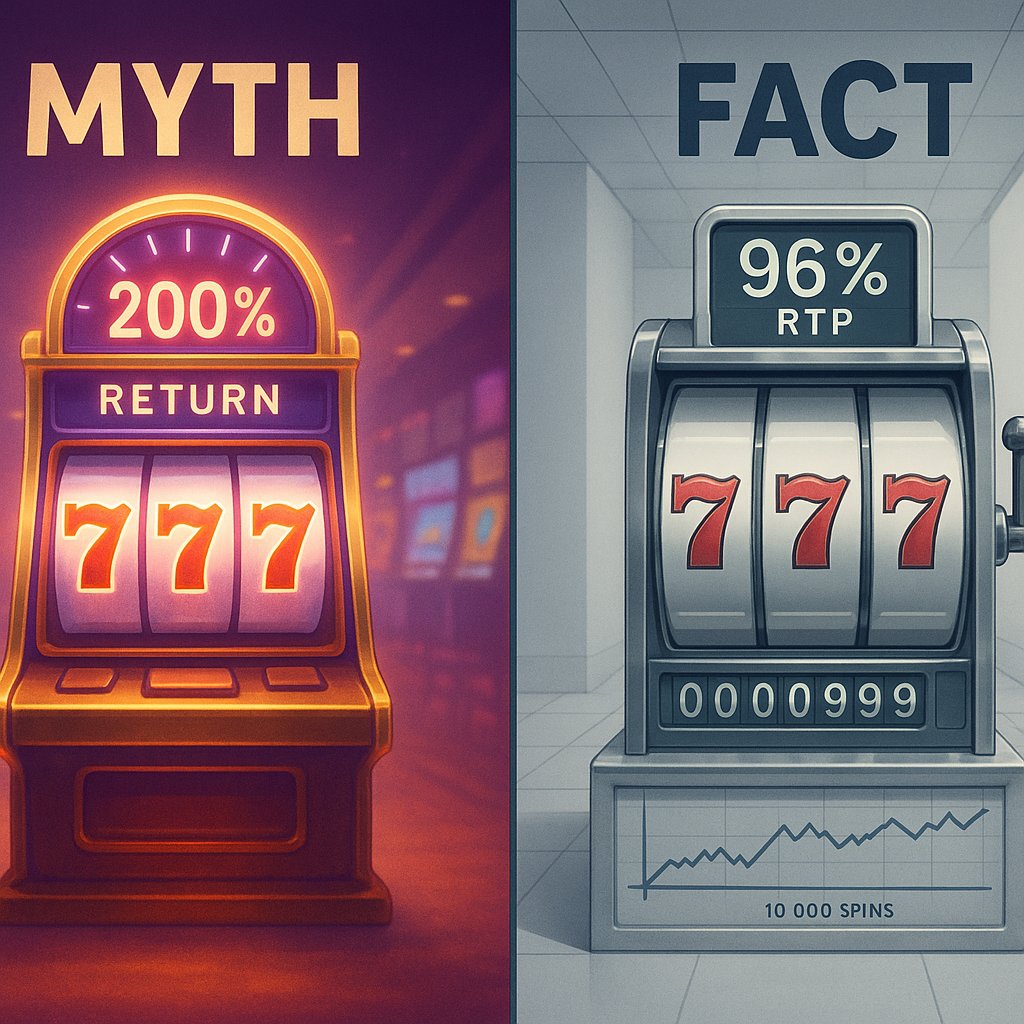
- Myth 1: “96% RTP means I get 96% of my money back this session.”
Fact: That 96% is a long-term average. Over a short session you can lose everything or hit a jackpot and be far above 100%. Even over 10,000 spins, results can land significantly above or below 96% because of volatility. - Myth 2: “RTP guarantees I will eventually break even if I keep playing.”
Fact: The math is unbiased toward any individual; it applies to the entire lifetime of the game across all players. Over time, the game converges on its RTP, not you. The more you play, the closer your expected result drifts to the house edge, which is negative. - Myth 3: “Online slots are rigged because I do not see the advertised RTP.”
Fact: Licensed online casino sites use RNGs audited by regulators. Variance and game design (high-volatility features, jackpots, long losing stretches) are what make your results zig-zag around the theoretical number. - Myth 4: “Casinos lower RTP on ‘hot’ days or after big wins.”
Fact: In regulated jurisdictions, slot and table game RTP settings are fixed in the game software. Operators can choose a legal configuration, but they cannot slide RTP up and down in real-time based on how players are running. - Myth 5: “Higher RTP means I will win more often.”
Fact: RTP says how much is returned on average; volatility determines how it is returned. A 96% high-volatility slot can have long droughts punctuated by huge hits, while a 94% low-volatility slot might pay much more steadily.
Slots at 96% RTP: What Happens Over 10,000 Spins
To understand what 96% really means, focus on expected value over a large number of bets. Suppose you play an online slot with:
- RTP: 96% (house edge 4%)
- Average bet: $1 per spin
- Total spins: 10,000
The math behind your expectation is straightforward:
- Total amount wagered: $1 × 10,000 = $10,000
- Expected total returned: 96% of $10,000 = $9,600
- Expected loss: $400
Crucially, this is an average outcome over many such 10,000-spin samples, not a promise. On a high-volatility slot, those 10,000 spins sit in the shadow of a few large features or jackpots that may or may not trigger for you.
Two real-world implications that online slot guides consistently stress:
- Same RTP, different experiences: A 96% cluster-pay slot with huge multipliers may feel brutal for thousands of spins then suddenly return a massive bonus that vaults the sample above 100%. Another 96% low-volatility title might grind your bankroll more predictably.
- Small house edge, big total cost: 4% sounds low, but over 10,000 bets it translates into a sizeable expected loss. If you double your bet size or your number of spins, you roughly double the expected cost of that edge.
That is why many experts recommend avoiding online slots with RTP below about 95% whenever you can find better options. Every 1% of house edge compounds across thousands of spins.
Blackjack and Video Poker: Why RTP Depends on You
Blackjack and video poker are often presented as “99%+ RTP games,” but that headline number assumes you are playing almost perfectly. Unlike slots, where RTP is fixed regardless of your choices, these games let you influence actual return with your decisions.
Blackjack over 10,000 hands
- Typical theoretical RTP with basic strategy: ~99%+
- House edge: ~0.5% or less at good rules
- If you bet $10 per hand for 10,000 hands, you are wagering $100,000. With a 0.5% edge against you, your expected loss is about $500 over the long run.
- If you routinely make big strategy errors (standing when you should hit, taking insurance, etc.), your effective RTP can drop several percentage points, multiplying your expected loss.
Video poker over 10,000 hands
- Top-tier games like full-pay Jacks or Better can reach ~99.5%+ RTP with optimal strategy.
- At $1 per credit and 5 credits per hand ($5 total), 10,000 hands means $50,000 wagered. With a 0.5% house edge, the long-run expected loss is ~$250.
- Misplaying hands (holding the wrong cards, chasing inside straights, etc.) can drop real-world RTP into the mid- or low-90s, rivaling mediocre slots.
Practically, that means:
- Table and video poker RTP is conditional: The advertised return assumes near-perfect play. Your actual RTP may be far worse.
- Skill narrows the gap: Study basic blackjack strategy charts or video poker hand rankings if you care about minimizing house edge over large samples like 10,000 hands.
Variance and Volatility: Why 10,000 Bets Still Is Not “Guaranteed”
Health and psychology content often reminds readers that humans are wired to seek patterns, even when outcomes are random. That tendency shows up in online casino play: people expect short-run fairness that the math simply does not deliver. The problem is variance.
Variance (or volatility) describes how widely actual results swing around the game’s expected value. Two games can share the same RTP yet feel completely different over 10,000 bets:
- Low-volatility slot, 96% RTP
You may see frequent small hits, relatively shallow downswings, and a session graph that looks like a gentle downhill slope. Over 10,000 spins, you might end close to the expected 4% loss. - High-volatility slot, 96% RTP
You may experience prolonged losing streaks and sudden huge wins. Over 10,000 spins, you might be far below expectation if key features never hit, or well above 100% if you land big bonuses.
This volatility also exists in blackjack and video poker. Even with a thin house edge, short- to mid-term swings can be large. A player can run hot over 10,000 hands and show a profit despite a negative expectation, while another loses faster than the math suggests.
The takeaway is uncomfortable but vital: even at 10,000 spins or hands, RTP is a statistical target, not a guarantee. Avoid building betting systems that assume that “the numbers must catch up” within your limited bankroll or timeframe.
RTP Across Slots, Blackjack, Video Poker, and Sports Betting
To make better decisions at an online casino or multi-product betting site, it helps to compare RTP (or its sports equivalent) across verticals:
- Online slots
Typical RTP: ~94%–98%. High-volatility bonus slots may cluster much of this return in features and jackpots. Lower-volatility titles spread it more evenly. - Blackjack
Typical RTP: ~98%–99.5% with good rules and correct play. Misplay adds a hidden edge for the house. - Video poker
Typical RTP: ~95%–99.5% depending heavily on pay table and skill. Full-pay games at reputable casinos can be among the best bets in the building. - Table games like roulette or keno
RTP varies; many standard roulette wheels sit in the mid- to high-90% range, while keno can drop into the 70s, making it one of the worst values. - Sportsbetting
Sportsbooks do not advertise RTP; instead, the key number is hold or vig on markets. On many main lines, real-world hold might approximate a “house edge” in the mid-single digits. Parlays often carry higher hold because payouts are priced aggressively.
From an expected-value standpoint, if you are determined to gamble, focusing on high-RTP games (blackjack, good video poker, solid 96%+ slots) is generally less costly than random low-RTP slots, keno, or heavily juiced parlay cards. The math does not make any option profitable by default, but it does change how fast you are expected to lose across 10,000 wagers.
Bankroll, Bet Size, and 10,000-Spin Reality Checks
Healthline’s coverage of topics like cognitive load and habit formation underscores something gamblers often overlook: your mental state degrades as stress rises. Managing bankroll and expectations helps blunt that stress when variance hits.
Here is how to think about 96% RTP over a large sample in practical terms.
1. Project your total wagering, not just your deposit
- If you bring $200 to a 96% slot and bet $1 per spin, a 500-spin session means you are wagering $500 total, not $200. Over many such sessions, the 4% edge applies to the total amount cycled through the game, not just what you started with.
- At 10,000 total spins of $1, you are effectively “risking” $10,000 in volume, with a long-run expected loss of about $400 at 96% RTP.
2. Use smaller bets to stretch volatility
- High-volatility slots and aggressive blackjack spreads create large swings. Reducing your unit size gives variance more room to play out without wiping you out quickly.
- For casual play, many seasoned players target staking 0.5%–2% of their bankroll per bet. That will not overcome house edge, but it helps you avoid catastrophic busts during normal variance over hundreds or thousands of bets.
3. Do not chase RTP with “double or nothing” systems
- Martingale and similar systems do not change RTP. They only change the distribution of outcomes: more small wins and occasional extremely large losses.
- If anything, tying bet size to emotional reactions (“I am due to win”) accelerates losses relative to a stable staking plan because you are betting more precisely when variance is going against you.
RTP can help you compare games, but bankroll discipline is what decides whether you experience that RTP gradually or blow through your funds in a handful of bad streaks.
Using RTP Smartly at Online Casinos and Betting Sites
RTP is not a secret edge, but it is a powerful filter when you combine it with game selection and risk limits at any online casino or all-in-one betting platform.
1. Check RTP before you commit
- On regulated online casinos, open the game info panel (often an “i” icon) to see RTP. If it is significantly below 95%, consider picking something else unless you have a specific reason (e.g., a giant progressive jackpot).
- Consult trusted third-party reviews and RTP databases when the lobby does not clearly show percentages.
2. Prefer transparent, regulated operators
- Look for casinos licensed by recognized authorities and audited by independent labs. Sites like BettingUSA and TheGambleTimes emphasize that this transparency is your best protection against unfair games.
- If a casino cannot or will not disclose RTP ranges for its library, that is a red flag.
3. Balance entertainment vs expectation
- It can be rational to choose a slightly lower-RTP game you find fun over a dry, ultra-high-RTP alternative, as long as you understand the trade-off in expected cost over 10,000 bets.
- Set loss and time limits before you start, and treat anything you lose as the cost of entertainment, not an investment.
4. Keep parlay-style risks in perspective
- In sportsbetting, parlays combine multiple legs into one high-variance ticket, typically with a higher underlying hold than single bets. That is similar in spirit to lottery-like high-volatility slots: high upside, but large expected loss over volume.
- Use parlays and ultra-high-volatility casino games sparingly if your goal is to keep long-run losses closer to the theoretical house edge.
When you compare multiple casinos or hybrid sportsbook-casino platforms, prioritize fair RTP, clear terms, and strong banking options over flashy promotions. If you are looking to try a new operator, you can explore a vetted betting site via this secure sportsbook and casino signup link and then apply the RTP principles in this guide as you choose games.
FAQ: Online Casino RTP Myths vs Facts
Q1: Is a 96% RTP slot “good” compared to other casino games?
A 96% RTP slot is decent for online play and often better than many brick-and-mortar machines, especially low-denomination ones that can sit in the high-80s to low-90s. However, it is still worse than well-dealt blackjack or full-pay video poker, which can reach 99%+ RTP with correct play. Over 10,000 spins, a 96% slot still carries a meaningful expected loss.
Q2: How many spins does it take for a slot’s RTP to “kick in”?
There is no fixed number of spins where results suddenly converge to the exact RTP. Even at 10,000 or 100,000 spins, variance—especially on high-volatility slots—can keep your actual return well above or below the theoretical value. RTP is a lifetime, game-level statistic, not a personal guarantee attached to your session length.
Q3: Can casinos secretly change RTP day to day?
On licensed platforms, casinos cannot dynamically change RTP on the fly. Each slot configuration is approved by regulators, and changes require updating or replacing the certified game version. What casinos can do is choose among legally allowed RTP settings when they first deploy a title, so two casinos may offer the same game at different returns.
Q4: Why does my experience not match the advertised RTP?
Short-run variance, game volatility, and, for skill games, your own decisions explain most discrepancies. A 99% blackjack RTP assumes near-perfect basic strategy; a 96% high-volatility slot assumes you eventually see the full distribution of features and jackpots. In a few hours of play, neither condition is guaranteed.
Q5: Are slots with published RTP safer than those without?
Publishing RTP does not make a game safer in an absolute sense, but it signals transparency. If a casino or game provider clearly posts RTP ranges and is under recognized regulation, you can at least compare options. When RTP is hidden and oversight is weak or unclear, you have far less information about the true house edge.
Q6: How does RTP compare to the edge in sportsbetting?
In sportsbetting, the equivalent of RTP is the bookmaker’s hold or margin embedded in odds. On major markets, this often works out to a few percentage points against you; same idea as a house edge in casino games. Parlays, props, and niche markets often carry higher effective margins, making them closer in cost to low-RTP casino games than to sharp single-line wagers.
Conclusion: Treat RTP as a Compass, Not a Promise
RTP is one of the most useful numbers in gambling if you understand what it is—and what it is not. A 96% slot does not guarantee you will get 96% of your bets back over a night, a week, or even 10,000 spins. It simply describes the long-run return baked into the game’s math across all play.
Use RTP to compare games, steer away from poor-value options, and anchor realistic expectations about what thousands of bets mean for your bankroll. Combine that with disciplined staking, awareness of volatility, and a clear separation between entertainment and financial goals. Whether you are spinning slots, grinding blackjack or video poker, or mixing in sportsbetting parlays on the same betting site, the underlying principle is the same: the house edge compounds over volume, and your best defense is informed, controlled play.