Table of Contents
- Overview: Why Table Game Habits Matter More Than Hot Streaks
- Blackjack: 6 Subtle Mistakes That Turn a Beatable Game Into a Money Pit
- Roulette: 6 Quiet Edge Boosters Hiding in Plain Sight
- Baccarat: 5 Misunderstood Rules That Quietly Tax Every Session
- Conclusion: Bring Sportsbetting Discipline to Every Table Game Session
- FAQ
Overview: Why Table Game Habits Matter More Than Hot Streaks
Expert Insight: According to thesportseconomist.com, one of the most dangerous gambling mistakes is “chasing losses,” and players are advised to treat gambling money like entertainment spending—never wagering more than they’d comfortably spend on something like dinner and a show, with no expectation of getting it back (https://thesportseconomist.com/mistakes-you-are-making-with-gambling/). (thesportseconomist.com)
Blackjack, roulette, and baccarat look simple on the surface, especially at an online casino where everything is one click away. But the quiet bankroll killers in these games are not single bad beats or cold shoes; they are repeatable habits. The same discipline that separates sharp sportsbetting from emotional parlays applies directly to table games: know the math, know the rules, and control your risk.
Below are 17 costly habits that repeatedly show up in real player data. They are grouped by game, with a final section on cross-game mindset mistakes. Fixing even a few of these can flatten your losses and stretch your bankroll far longer on any betting site.
Blackjack: 6 Subtle Mistakes That Turn a Beatable Game Into a Money Pit
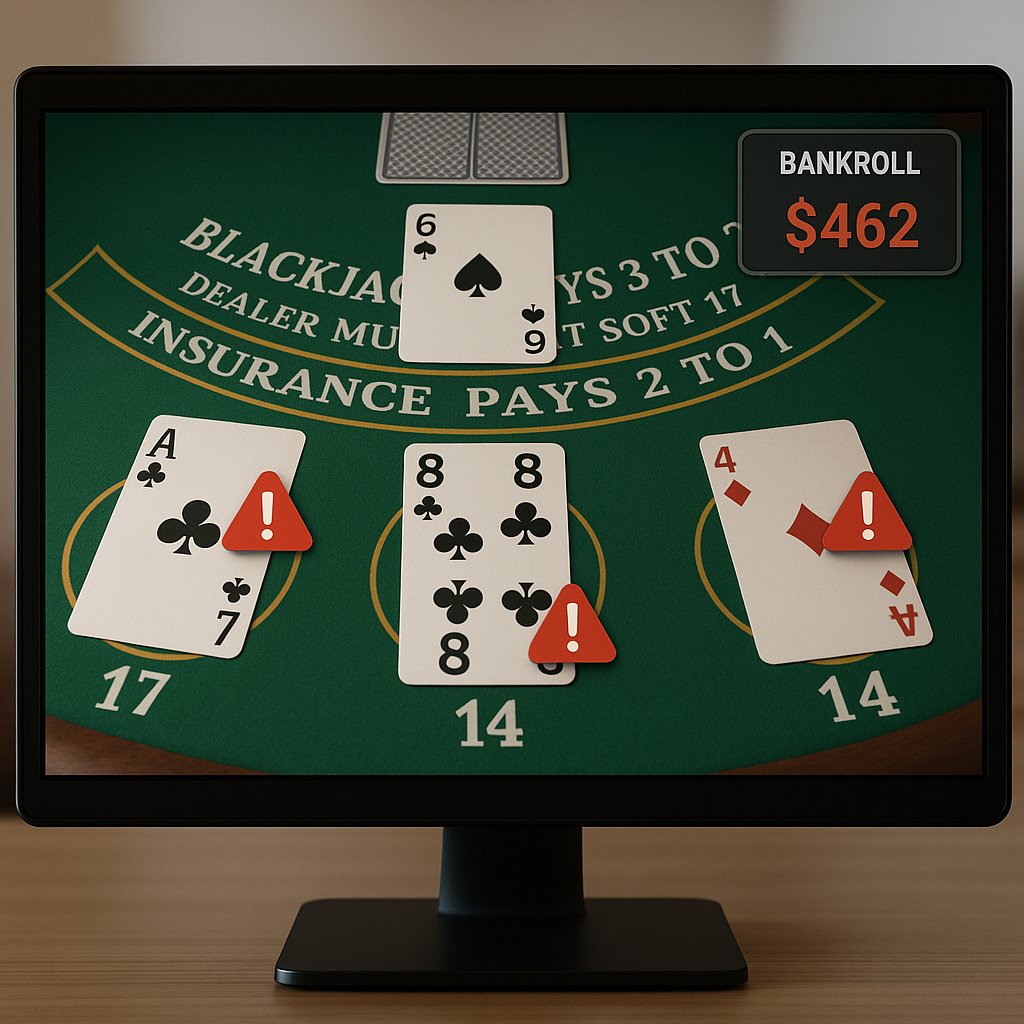
Blackjack is one of the few casino games where you can get close to even against the house if you stick to optimal strategy. That is exactly why small leaks here are so expensive: every deviation is extra edge you hand back to the online casino.
Mistake 1: Playing Without Basic Strategy
Many players “go with their gut” instead of using a basic strategy chart. The cost is huge:
- Perfect basic strategy can keep the house edge near 0.5% on good-rule games.
- Random, seat-of-the-pants decisions can push that edge above 2–3% or worse.
The fix is simple: download or keep an on-screen basic strategy chart that matches the exact rules and number of decks. Most reputable resources and training tools are built on the same math used by sites like Wizard of Odds.
Mistake 2: Ignoring Rule Variations (6:5, H17, Side Conditions)
Not all blackjack tables are equal. Costly rules appear frequently online:
- 6:5 blackjack payouts instead of 3:2 (a massive hidden tax on your best hands).
- Dealer hits soft 17 (H17), adding house edge.
- Restrictions on doubling after split or on re-splitting aces.
If you sit down without reading the table rules, you might be giving up ten times more edge than you think. Scan the info panel: favor 3:2 payouts, dealer stands on soft 17, and flexible doubling rules.
Mistake 3: Refusing to Hit or Split Out of Fear
“Never bust” sounds smart but is mathematically wrong. Common leaks include:
- Standing on stiff totals (12–16) against strong dealer upcards that you should hit.
- Refusing to split 8s or aces because you “don’t want to lose more” on the hand.
These mistakes feel safe in the moment but slowly bleed your bankroll. Basic strategy already accounts for bust risk; ignoring it turns a close game into a long-term losing grind.
Mistake 4: Misusing Insurance and Even-Money
Insurance looks like protection but is usually a bad standalone bet, with a steep house edge. Taking insurance or even-money every time you have a blackjack against a dealer ace is a textbook leak.
- Unless you are counting cards and know the deck is rich in tens, skip insurance.
- View it as a side bet, not “protection” you owe yourself.
Mistake 5: Using Martingale or Aggressive Progressions
Doubling your bet after every loss (Martingale) or similar systems feel like a guaranteed way to “eventually” win. In reality, they collide with:
- Table limits that cap how far you can chase.
- Finite bankrolls that run out faster than you think.
The math is clear: a short streak of bad variance plus a progression system can erase hours of steady play in minutes. Smart blackjack play means flat or modestly scaled bet sizing tied to your bankroll, not blind doubling.
Mistake 6: Playing Too Fast in Live and RNG Blackjack
Online blackjack hands resolve much faster than in a physical casino. That speed magnifies every mistake:
- More hands per hour means more exposure to house edge and bad decisions.
- Autoplay and rapid re-bet buttons make it easier to tilt without realizing it.
Set a pace: limit your hands per session, and take short breaks whenever you double your starting stack or fall to a pre-set stop-loss. Discipline here mirrors the best practices of serious sportsbetting: fewer, better decisions instead of nonstop action.
Roulette: 6 Quiet Edge Boosters Hiding in Plain Sight
Roulette is marketed as pure fun, but rule sets and bet choices drastically change your long-term results. With no strategy element like blackjack, your only real lever is choosing which wheels and bets to play.
Mistake 7: Playing American or Triple-Zero When Better Options Exist
House edge depends heavily on how many green zero pockets the wheel has:
- European (single zero): about 2.7% house edge.
- American (0 and 00): about 5.26%.
- Triple-zero (0, 00, 000): even higher, often above 7%.
If your online casino offers single-zero wheels and you still choose double- or triple-zero because they look “more exciting”, you are voluntarily paying 2–4+ extra percentage points on every spin.
Mistake 8: Believing in Hot Numbers, Cold Streaks, and Dealer Bias
Random-number-generator roulette and well-maintained live wheels do not remember past spins. Common bankroll killers include:
- Martingale-style progressions on red/black or odd/even after “too many” of one color.
- Chasing “due” numbers because of long gaps on the statistical history board.
Every spin is independent. Patterns you see are noise, not signals you can exploit long term.
Mistake 9: Overloading on Inside Bets With Poor Bankroll Planning
Inside bets (straight-up, splits, streets) offer big payouts but low hit frequencies. Recreational players often:
- Sprinkle chips all over random numbers without a clear staking plan.
- Underestimate how many losing spins they must survive between hits.
Without proper bet sizing, a few dry spells can wipe out your session before variance evens out. Mixing a small, consistent outside bet (like red/black) with selective inside bets can smooth the ride.
Mistake 10: Confusing Table Limits and Bankroll Requirements
People often pick tables based purely on minimum bet, ignoring maximums and their actual bankroll. This is especially dangerous when combined with progressions:
- Low minimums but relatively low maximums can trap you mid-chase.
- High minimums shorten your time to ruin if variance runs against you.
As with a risky parlay on a betting site, the problem isn’t the single spin; it’s committing too much of your roll to a short sequence of events that can easily go wrong.
Mistake 11: Misusing Special Bets and Racetrack Layouts
French and European layouts often provide call bets and racetrack-style groupings (Voisins, Tiers, Orphelins). These are useful tools but turn into leaks when:
- You treat them as “lucky sections” instead of structured coverage.
- You stack them randomly, creating overlapping exposure you don’t track.
Before placing these bets, understand exactly how many numbers you’re covering and what your total stake per spin is. If you cannot explain your risk in one sentence, your bet is already too messy.
Mistake 12: Playing at Maximum Speed
Auto-spin features, turbo modes, and instant results make roulette dangerously fast online:
- Fast spins mean more exposure to edge and variance per hour.
- Quick re-bet buttons make emotional chasing nearly effortless.
Cap the number of spins per session and avoid turbo modes. Just as smart sportsbetting avoids firing endless live-bet parlays out of boredom, smart roulette players manage the tempo of play to protect their bankroll.
Baccarat: 5 Misunderstood Rules That Quietly Tax Every Session
Baccarat looks like a coin flip between Player and Banker, which is why it is so popular in online casino lobbies. Under the surface, the drawing rules and side bets create meaningful differences in long-term results.
Mistake 13: Ignoring the Small but Real Edge Difference Between Bets
Baccarat has three core bets:
- Banker: Lowest house edge, even after commission (often around 1.06%).
- Player: Slightly worse edge, but still solid (around 1.24%).
- Tie: Very high house edge, usually 14% or more depending on payout.
Consistently favoring Banker and Player while largely avoiding Tie is one of the simplest, most powerful ways to protect your bankroll.
Mistake 14: Chasing Trends on the Scoreboard
Baccarat scoreboards (roads) tempt you to spot “patterns”: streaks, zigzags, and shoe “signatures.” Common errors include:
- Overbetting on streak continuation (“Banker is hot”).
- Doubling after every loss expecting a switch (“Player is due”).
The dealing process and drawing rules do not respond to patterns you see in the display. Treat the board as entertainment, not a system.
Mistake 15: Hammering High-House-Edge Side Bets
Pair bets, dragon bonuses, and other side wagers in baccarat can have much higher house edges than the main bets. They feel like an easy way to “spice things up,” but over time they drain more than they pay back.
- Use side bets sparingly and at tiny stakes relative to your main bet size.
- Check the posted return-to-player (RTP) where available; if it is far lower than Banker/Player, treat it like a novelty, not a core strategy.
Mistake 16: Ignoring Table Commission and Payout Details
Some baccarat tables tweak the standard 5% commission on Banker wins or introduce alternative payout structures (like 6:5 Banker on certain totals). If you do not read the rules:
- You might think you are playing a low-edge game when the conditions are actually worse.
- You can under- or overestimate your expected loss per shoe.
Always read the information panel for commission, drawing rules, and any special conditions tied to specific totals.
Mistake 17: Betting Too Big Relative to Bankroll Because It “Feels Safe”
Baccarat’s perceived simplicity encourages oversizing bets. People assume:
- “It’s just Banker vs Player; I can go larger.”
- “Variance will be lower than in something complex like blackjack.”
In reality, the short-term swings in baccarat are just as real as in other table games. Follow a simple rule borrowed from sharp sportsbetting: stake a small, consistent percentage of your total bankroll per hand (often 0.5–2%), not a random chunk driven by gut feeling.
Conclusion: Bring Sportsbetting Discipline to Every Table Game Session
The same habits that separate sustainable sportsbetting from reckless parlays will protect you in blackjack, roulette, and baccarat. Know the rules, understand the house edge, avoid high-cost side bets and progressions, and stake a consistent fraction of your bankroll instead of reacting emotionally to short-term results.
Pick games and tables with the best math, not the flashiest animations. Treat every session on any betting site as part of a longer journey, not a one-night score. If you want a single place to apply those principles across multiple markets, you can explore a regulated betting site that offers both sports and online casino action, then build a clear plan for how much you will risk and where.
Whether you are at a virtual blackjack table, watching the roulette wheel spin, or sweating a baccarat shoe, your edge is not in guessing the next outcome. It is in eliminating these 17 quiet leaks so your bankroll lasts long enough for the entertainment to be worth the cost.
FAQ
Q: What are the most common bankroll-killing mistakes in online table games?
A: The biggest leaks are betting too much per hand, chasing losses, playing without fixed limits, and ignoring basic strategy or odds. These habits quietly snowball over long sessions and make even decent players lose much faster than they should.
Q: How is smart blackjack play different from just ‘going with your gut’?
A: Smart blackjack relies on basic strategy charts based on math, not hunches about when a win is ‘due.’ Guessing leads to standing or hitting at the wrong times, giving the house a bigger edge on every hand you play.
Q: Why do roulette betting systems like Martingale drain your bankroll?
A: Systems that double your bet after every loss seem logical but quickly hit table limits or wipe out your balance during a losing streak. You’re still playing a negative-expectation game, just with bigger and riskier swings.
Q: What’s a typical mistake baccarat players make online?
A: Many players constantly switch between Player, Banker, and Tie based on recent results or ‘patterns’ in the roadmaps. This adds unnecessary risk, because the house edge is lowest on Banker and doesn’t change based on previous hands.
Q: How is table game discipline different from smart sports betting strategy?
A: In sports betting, you can sometimes find positive-value lines and use detailed analysis to gain an edge, so selectivity matters most. In table games like blackjack, roulette, and baccarat, the edge is built-in, so discipline means minimizing that edge and controlling how fast you expose your bankroll to it.